Get weekly tips, recipes, and my Herbal Jumpstart e-course! Sign up for free today.
Pennywort Benefits with April Punsalan
Share this! |
|


Everyone’s trying to get rid of it—but around the world, it’s treasured as medicine. What if pennywort could change the way you see your backyard?
Pennywort (Hydrocotyle spp.) is one of those plants that many people overlook (or actively try to remove!). Yet across the globe, it’s commonly harvested and enjoyed as both a nourishing food and a traditional remedy. In this conversation, herbalist and botanist April Punsalan shares how this unassuming, persistent plant became one of her most meaningful allies.
Drawing from her background with the U.S. Fish and Wildlife Service and years of hands-on experience with wild plants, April brings a unique perspective that blends ecology, science, and intuition. She explores pennywort’s rich chlorophyll content, its role as a fresh, nutrient-rich herb, and why she prefers working with it in simple preparations that feel more like daily nourishment than “taking medicine.” Along the way, she invites us to rethink our relationship with the plants growing all around us—and to consider what we might discover if we slow down enough to truly notice them.
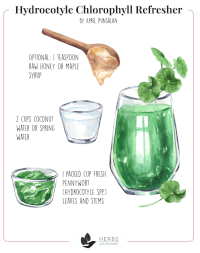
April shares a simple, vibrant way to bring fresh plant nourishment into your daily routine with her Hydrocotyle Chlorophyll Refresher. You can download your beautifully illustrated recipe card for this delightful, energizing drink from the section below.
By the end of this episode, you’ll know:
► Why pennywort is so widely used around the world (even though it’s often seen as a weed in the US!)
► What makes fresh pennywort preparations uniquely potent—and why drying may reduce its benefits
► How the botany and habitat of pennywort can help clue you in to its health benefits
► Several ways pennywort can support your health—providing benefits for the skin, the urinary system, the brain, overall vitality, and more!
► Why herbalism is as much about connecting with plants as it is about their medicinal uses
► and so much more…
For those of you who don’t know her, April Punsalan is a botanist, herbalist, author, and founder of Wild Herb Academy, an online school devoted to ecological remembrance and plant-based healing. A former botanist for the U.S. Forest Service and U.S. Fish and Wildlife Service, she spent years protecting endangered plants before answering a deeper call to teach.
April’s lifelong relationship with plants led to degrees in botany and more than twenty-eight years of studying medicinal and edible species. Today, she weaves together botany, ethnobotany, Ayurveda, and intuitive plant wisdom, helping people reconnect with the Earth as stewards, healers, and conscious participants in the living ecosystem worldwide today.
Whether you’ve been pulling pennywort out of your garden or walking past it without a second glance, I hope this episode inspires you to pause, look closer, and maybe even begin a new relationship with this humble plant.
Click here to access the audio-only page.
-- TIMESTAMPS -- Pennywort Benefits
- 0:44 - Intro to April Punsalan + her plant path
- 13:13 - Challenges facing plant and ecosystem preservation
- 20:03 - Why April chose to speak about pennywort (Hydrocotyle spp.)
- 22:35 - Medicinal benefits of pennywort
- 25:38 - Hydrocotyle Chlorophyll Refresher recipe
- 33:58 - The value of patience, attention, and intuition in herbalism
- 38:59 - April’s current herbal projects
- 45:26 - Something herbs taught April that she wasn’t expecting
- 49:14 - Student spotlight
- 50:18 - Herbal tidbit
Get Your Free Recipe!
i
Connect with April
- Website | WildHerbAcademy.com
- Instagram | @wildherbacademy
- Facebook | Wild Herb Academy
Transcript of the 'Pennywort Benefits' Video
Welcome to the Herbs with Rosalee Podcast, a show exploring how herbs heal as medicine, as food, and through connecting with the living world around you.
Today’s episode is about pennywort, a plant that depending on where you live, might be something you’ve spent years trying to get rid of. My guest is April Punsalan, who has a fascinating background that includes botany and the US Forest Service. In this episode we talk about why pennywort is cherished in many places around the world, why April sees it as this plant rich in chlorophyll and antioxidants, and how she likes to work with it in simple, everyday ways that feel more like nourishment than taking something. If you’ve ever looked at a plant in your yard and thought, “Ugh, not you again,” this one might change your perspective.
If you enjoy this episode, please give it a thumbs up so more plant lovers can find us, and be sure to stay tuned until the very end for your herbal tidbit.
Tired of herbal overwhelm?
I got you!
I’ll send you clear, trusted tips and recipes—right to your inbox each week.
I look forward to welcoming you to our herbal community! Know that your information is safely hidden behind a patch of stinging nettle. I never sell your information and you can easily unsubscribe at any time.
Rosalee de la Forêt:
April, I’m thrilled to have you on the show. Thank you so much for being here.
April Punsalan:
Aww. Thank you for the invite.
Rosalee de la Forêt:
Absolutely! I’m really looking forward to hearing about the plant you’ve chosen because I will say - completely new to me, so I’m excited. I’m really excited for your recipe as well. Before we get there, I’m also very interested to hear about all the things that have led you on this plant path because you have this incredible background – US Forest Service, botany, on and on. I’m going to let you tell your own story, but I’m—I’m excited to hear it.
April Punsalan:
Thanks for bringing me on the show. It’s nice to finally get to meet you, and even though we’re virtual, I feel like this—the herbal world is such a small world and so I know we are connected even though we haven’t met yet. So thank you.
I—the plants, you know, I feel they definitely saved my life and that I was very blessed to find the path at a young age. I was in horticulture, but I actually was signed up for computers. This was—I’m going to give away my age. This was like 1997, and I was in computers because computers were going to be the thing, right? My mom was like, “You ought to do computers. That’s where all the money’s at!” I was in there and I was falling behind terribly. We did a tour of the school and I saw a greenhouse. There was a sweet, beautiful woman with these students around her. It was like—Eric was his name and then this other—I forget the other girl’s name—and they were planting pansies. I was like, “What is that?” She said, “Horticulture.” I had—it was a two-year program so I had to stay in school for another year if I wanted to do it. My mom was very hesitant, but then the counselor, whose name was Ms. Hart, was like, “Hey, she really loves it. You should let her,” and so my mom did. And then it was kind of like—that was the—that was just how I found myself. Then I was in—after school, reading Birds & Blooms magazine. She fostered my love for herbs and she bought even organic herb seeds and had me do state fair competitions with herbal shampoo and lotions. I started making herbal medicine and herbal products in high school. My mom was a single mother and had three children, and she—we didn’t have health insurance, and so I healed myself with plants. I had James Duke—The Green Pharmacy. I read that and Rodale’s herbal encyclopedia, which I still pull out that book, which I’m like wow! That says a lot about that book.
And so, that was that, but my mom—being raised by a single mother and being poor according to society, whatever, she was like, “You’re going to get your master’s.” It was drilled into my head because both of my aunts had their master’s and they were—they would help my mom. They would send her money, and so she—my mom was like, “You’re going to do that and you’re not going to struggle like me.” I kind of knew that that was going to be my path that I was going to go in. I did botany because I love plants, obviously. I went to UNCA, Asheville and Western Carolina University. I was able to be in the Southern Appalachian Mountains, which you probably know is a biological hotspot for plants because the—they have—they’re like—they—they say that they used to be a part of the Himalayan Mountains and they never experienced glaciation, so all these Northern species just retreated to the Southern Appalachian Mountains, but there’s still these relictual species on the top of the 5,000 feet above elevation. I got to train with some of the best botanists in the Southeast. I was—I was given the assignment to find these rare plants in the middle of the woods. To find the rare plants, you’ve got to know all the common ones, and so I started working on that and learning all the flora.
My husband was like, “Hey, you’ve got to get me out of Asheville because I am Filip—half Filipino and I got eczema in the winter, and I play reggae music.” And I’m like, “Look honey, you need to [unclear] and you need to learn how to play bluegrass music. You could get gigs.” He’s like, “I’m not getting any gigs here. I’m dying.” I’m like, “Okay.” At that time, they were like, “April, you have to reapply for your job because we want to increase the grade level. You got to get on USAJobs.” I’m like, “I’ve never been on USAJobs. Let me just get on there since I have to compete for my job,” and so I get on there. Lo and behold, there’s a botanist position in Charleston, South Carolina with U.S. Fish and Wildlife Service. Everyone said, “You’re not going to get that job. Department of Interior just hires Department of Interior. You’re Department of Ag.” I was like, “Hey, you know”—and this is for anyone who ever wants a USAJob, botanist job, I highly recommend calling the point of contact because they were like, “They don’t have anyone in mind for this job.”
So next thing you know—it was like a month later I moved to Charleston and took the botanist position for the U.S. Fish and Wildlife Service, which was then protecting [unclear] endangered plants across the East Coast. That’s wholly different because that’s policy. No longer was I really in the field. I had to work really hard to get in the field and I had to do a lot of rigorous science. What that showed me was how much habitat destruction there is and how disconnected humans were. It was almost like spirit was like, “Okay, you have to teach now,” because at this point, I’m looking at all these amazing plants then there’s so—most of them are edible and medicinal, but very few people are connecting with them. I just see this “missing link” of like, “Hey, this is the problem” because if we could save thousands and millions of acres of land as conservationists but people don’t even know how to connect with it anymore and people don’t even know what we’re really doing in the offices and we’re working so hard. I worked really hard to see if a species was going to be federally listed. It wasn’t and that was okay. But all that being said is that it’s—federal government is never going to save and protect all the species and—and so I had to teach.
That’s when I left—well, I actually formed the school. This is for people that want to leave their 9:00 to 5:00 and they have a side hustle, definitely keep doing it because that’s what I did. I did that for three years. At that time, when I first started, I just called it “Healing Plant Traditions.” I had no idea what I was doing. I just knew I had to do—I was doing something different. And then it changed. It transformed into Yahola Herbal School, and then it transformed into now, Wild Herb Academy. I just wanted to be clear that I’m focusing mostly on wild plants. That’s how that happened. That’s a long story, but that’s it.
Rosalee de la Forêt:
I’m curious just to know a little bit more about what it was like to work for the Department of the Interior to this sort of thing because I just really have no idea. I feel like I should come up with a clever question, but I’m not sure what that question is. What kind of work did you do? What did you find inspiring or rewarding, and maybe what did you find challenging in that role?
April Punsalan:
That’s a good question. Yeah, it’s been a long time too. It—and I was in that position for eight years, which is crazy. That was a long time! I went in there hot. I had all this energy and started the South Carolina Plant Conservation Alliance. I would say the biggest thing is protecting these plants, like—because before they didn’t have a botanist, the federal government—the Department of Interior didn’t have any botanists on the East Coast at all. It was just fish and wildlife biologists because they didn’t see—because for plants, there are no—there’s no “take”. There—there—for wildlife species, it’s different and—and there’s going to be a lot more. The project is going to stop, but for a plant, not very much, so the fact that they hired a botanist was a huge deal. But they—so, my most rewarding part was actually being able to come in and have a voice for these plants that hadn’t had it.
I’ll give you one example, Schweinitz’s sunflower, a federally endangered sunflower. Every time DOT would do a project, they would just move the flowers and they would put it in a museum called the “Brattonsville Museum,” and they would just plant them there. I was like, “That’s not conservation and recovery because now, it’s just going to be at a museum and these populations aren’t functioning as populations.” I was like, “We’re going to dig them up. We’re going to safeguard them and then when you’re done with the DOT project, we’re putting them back.” That was—it was nice to be there; to be in that role and to—to really be able to be a voice for the plants. Everyone was really—honored that. Everyone came to me for advice. It was amazing how much I was respected in that role. It wasn’t like, “Oh, my gosh, we have a botanist.” It was like, “We have a botanist! We can go ask her,” so it was hard to leave.
The hardest part was having to do all the policy-driven work and to be within the policy and do these five-year reviews. When you become a botanist or a fish and wildlife biologist for the federal—for U.S. Fish and Wildlife Service, you have to do what’s called “five-year reviews.” They’ll give you certain species like, “You’re now the national lead for XYZ and you’re responsible for their recovery.” When you get that it feels great because you’re like, “Oh, my gosh, I can work with all these partners. I can do all this great work,” and you can! There are no limitations on what a fish and wildlife biologist or botanist can do with the U.S. Fish and Wildlife Services. Barely. If you have the energy. But then when you get into the policy of everything you have to send the government or you have to submit, it’s like, oh, gosh. It’s like writing a master’s again. So, when I had to do that…it’s called “species status assessment” to determine if a species is going to be federally listed. It was like a whole year. It was like a 300-page document. That’s kind of when I was like, “I didn’t sign up for this. I can’t do this work. I have to be outside. I have to be with the plants.” At that time, that’s when it was like I have to teach. But anyway, the most rewarding is actually getting to help the plants, and then the most challenging is all that writing that you have to do.
Rosalee de la Forêt:
It is interesting. The thing about that is—because I’m sure most botanists—we know that we want to be with the plants. Just even—one of my good friends is a—works for Fish and Wildlife. He’s a—a fish bot—a fish botanist—a fish biologist and he loves being in the rivers with the fish, so I can imagine that’s a tough one on that.
Hey, there. Just a quick note: if you’d like to hear from me in a more personal way, I’d love to have you in my free text community. I send a couple of texts every week, things like behind-the-scenes updates, herbal thoughts that I’m chewing on, and little sparks of joy I don’t always share anywhere else. To join, just text the word ROOT to 1-509-383-8398, and if you ever want to break up, no hard feelings. Just text STOP to the same number and you’ll be opted-out immediately. My goal is to make it so juicy and so fun that you look forward to getting my texts each week. Okay, now back to the show.
I imagine that I know the answer to this, but I’m just curious to ask what do you see as some of the biggest challenges facing plants in terms of being endangered and just the—the challenges that plants are facing right now?
April Punsalan:
I feel on the East Coast—that’s a really good question—on the East Coast, fire, because a lot of these ecosystems were fire-adapted, and because we have so many roads and schools and houses, we can’t do the fire, and so I had to go back to manuscripts and different things from early explorers from the 1700’s. They would say that the Indigenous people lit the woods on fire from October until March. There are plants that we’ll never see come back because we’re not able to do that. These ecosystems can’t function the way that they used to because of so much degradation and land alteration.
But yeah, definitely, all the stuff we buy from Amazon, every time we click “purchase,” that’s a huge impact. Our consumerism I think is huge. We don’t really see it because it’s not a direct impact, but as a former botanist, I would have to clear all the Amazon centers. Every time a distribution center—any kind of distribution center—went in, it would be like hundreds and hundreds of acres. All the stuff that we buy has to be stored somewhere. I would just think our—our insatiable desire for stuff and that driving that consumerism is the biggest risk to species. We could think about it every time we-
Rosalee de la Forêt:
Because then it’s like fueling habitat destruction? Sorry. I just wanted to-
April Punsalan:
Yeah, it’s fueling habitat destruction. I think of it as a take. Every time we buy something, whether it’s this microphone I’m talking into or that blue folder over there or my reader glasses, it’s a take from the environment. We have to think about it in terms of resources and really try and minimize how much stuff that we buy day-to-day because it really does have an impact on the habitat. Somewhere it’s having an impact. And then—and then too, just the disconnection between humans and nature. That’s huge! There’s that disconnect. I think—I don’t know if you’ve ever heard of Doug Tallamy, you would love him. He says “nature’s best hope is you.” He has a book and I love it, Nature’s Best Hope is you. He says if all of us let our yards rewild and we let the wild plants come in, then we could protect—we would have way more land than all the national parks in the nation. I think—I love that approach. It’s—it really has to start with us. Instead of thinking that it’s going to be in the federal government’s hands or policy, we really have to take responsibility for it. Even if our—even if we’re in an apartment. Even if we’re in the city and we have a tiny yard, we can make a difference.
Rosalee de la Forêt:
That’s beautiful, April. I love thinking about that too—just all of those lawns out there that could be rewilded. I’m forgetting the book now, but there’s a really great book out there talking about just how important our native plants are for our native pollinators and our insects—all these relationships that have grown so—for so long and are so strong, but if they don’t have their native plants in an area, that’s really important. I think of that flying over suburbs, literally flying above in a plane and looking down and just seeing—wow, there’s—because where I live, I’m surrounded by native plants so I kind of forget about that, then I look at these—how drastically changed these environments are and how they are missing their native shrubs and plants and all the insects and birds and beings that are longing to be a part of that cycle as well.
I also have to go back to what you said the first thing because I did not expect that, when you mentioned fire as being an important missing piece. My husband is just starting a prescribed burn association, which is working with local landowners to bring fire back to the landscape in sustainable safe ways. There’s all of these—at least on the West Coast, there’s a lot of move to do that and insurance being set up and organizations. He works with the DNR and US Forest Service and working to get this going. It’s just kind of starting. We’ve had a couple of burns on our property and it’s just so fascinating to watch the plants come back to life in just a really cool way. Through that, as you mentioned, it was a lot of honoring just the Indigenous ways of how they’ve tended the land for so long. Anyway, I didn’t expect you to say that and that was a very pleasant surprise. I will definitely be going to tell my handsome French husband about that as soon as we’re done.
April Punsalan:
That’s awesome that you have that—you can witness it and you can see the cycles because all the nutrients go back to the land when you do it with fire. There are so many species that depend on that. That’s awesome. It’s really hard here on the East Coast, really hard, but there are so many species that depend on it. There are a lot of botanists that are really good and they will time their excursions based on the last time the fire. They will know that only certain orchids are coming up after that fire. There’s a whole timing thing. I notice March fires some of the plants won’t do as good. This is right before some of the spring federally endangered plants will come up, so I would have to try and work with the Forest Service to get them to burn more in the fall which tends to be a little bit more natural timing; like the fall instead of early spring in March. Especially here in South Carolina where March is kind of like is the spring, not dormant.
Rosalee de la Forêt:
It’s so fascinating to hear from that perspective, and so thanks for sharing about that. And just that—that role—that botanist role and just how that might be changing, hearing about the DOT and just changing the landscape within how we actually conserve plants is really beautiful as well.
Hey, it’s Rosalee. You know, creating this podcast has been one of the most rewarding parts of my herbal work, and if you’ve found something meaningful here, whether it’s a new perspective, a favorite recipe or just a sense of calm, I want to let you know there’s a good way to go even deeper. It’s called the “Podcast Circle.” Inside you’ll get access to live classes taught by some of my favorite herbal teachers, behind-the-scenes updates, and a beautiful library of herbal resources that we’ve gathered over the years. But more than that, it’s a space to connect with fellow plant lovers who care about the same things you do. And truly, your membership helps make this podcast possible. It’s how we keep the episodes coming and the herbal goodness flowing. So, if you’re ready to be part of something more, something rooted in connection, head over to HerbalPodcastCircle.com. I’d love to see you there.
The plant that you’ve chosen, pennywort, I’m so excited about this because I did not recognize the plant name when I saw it come up, which is, I will say somewhat rare for me, and so then I looked up the plant then I was like, “Oh, that plant!” I see that plant everywhere but somehow we’ve really met before. I’m just ready to sit and learn from you about the plant. One question I often like to ask—and I’m especially interested in this for you—is, why did you choose this plant of all plants?
April Punsalan:
I think it’s because it’s—I wanted to pick something that’s on the West Coast too. I wanted to pick something that maybe not as many herbalists know about. I wanted to do—because I feel like we—we share some pretty good common herbs like lamb’s quarter or violets. We all—we all love and have a beautiful relationship with those, but pennywort is one of those ones, Hydrocotyle that in our—in North America or at least in the United States, not a lot of herbalists are working with, but if you go anywhere else around the world, it’s sold at markets. It offers just so many benefits, and so I felt like that’s why. And also, the recipe is super easy. You were like, “Give me a recipe,” and I’m like, “Okay, this recipe anyone can do, a busy entrepreneurial woman can make it in a heartbeat.” Anyone can do it and so I felt like it would be a good one to share and there’s—it grows on the East Coast and on the West Coast, but different species. That’s the whole thing I’m learning. Whenever I teach, I always teach Latin names. I teach them medical botany because I want them to know—they don’t have to rely on the one I have, which is Hydrocotyle bonariensis or the one that grows here. There’s Hydrocotyle umbellata, but the one on the West Coast is Hydrocotyle ranunculoides, and there are a couple of other ones. Knowing that just Hydrocotyle spp., which means all the species in Hydrocotyle, it will liberate you. They all have circular leaves that are super pretty and cute. It’s just a great herb to befriend—and also chlorophyll. With the recipe we’ll get into that. It’s all about getting the chlorophyll and the antioxidants into your body. I see it really as this anti-cancer herb that protects our body from free radicals and aging.
Rosalee de la Forêt:
Lovely! Where—you could start there or dive in somewhere else in terms of plant gifts and all the beauty this little guy has to share with us.
April Punsalan:
Yes, so it is—it’s a very—if you’ve never seen it, you should Google it, but I imagine you’ll maybe share a picture or the recipe. Hydrocotyle–it grows around the world. In India, they call it “brahmi.” They call it other names and they don’t even, a lot of times, differentiate between hydrocotyle and gotu kola. They see them the same. One time, a filmer from Sacred Science came and he was in my front yard. He was like, “Oh, my gosh, you have brahmi!” and he was talking about pennywort! Everyone here weeds it out! Everyone cannot stand this plant and they pull it out of their garden, but it’s so persistent and you cannot get rid of it. So, that speaks about its medicine because it will spread and it’s closer to the earth.
It has a really cool botany. It has a leaf shape called “peltate,” so you can hold it like an umbrella. It’s circular. It’s kind of scalloped along the leaf margin. It looks like, a lot of people say, the cerebellum of the brain. I think in India, they saw it as a doctrine of signatures and they—and they said that it’s really good for the brain and that it has a lot of antioxidants. The way that I see it in the landscape and I observe it, I’m like, yeah, that makes sense because it survives year round here. It’s very resilient and so that speaks to me that it has a lot of antioxidants. But it doesn’t have a lot of tannins in it or anything that keep us from consuming a decent amount, so we can consume more of it than other herbs. It just—I’m trying to think if there’s anything else that I want to say.
It’s closer to the earth, which I think is kind of cool. It has these stoloniferous rhizomes that are underneath the earth and it travels really far. The leaves are—they are—molecular science and science, modern research has shown us that the Indigenous people knew in India—know what they’re talking about because it is really, really high in antioxidants and it has shown to be anti-cancer against many different types of cancer. I don’t have them memorized. I’ve read—I went down a rabbit hole with it. I read so many periodic journal articles, but what I started thinking about is I’m just going to take this—a couple of leaves and just blend it in water because a lot of times—for a long time in my herbal path I made teas and—but as I am pitta, fire, and I—sometimes these teas have a lot of tannins and they’re maybe making my mouth dry, and so I really want cool, room temperature. I really want the chlorophyll and the medicine without the drying tannins and all that. I put it in—I put just the leaves in two cups of water and blend it on high speed. Lo and behold, it just turns this beautiful green color, and so I drink that and I get the antioxidants. But I did play around with it. It’s like any new wild herb that you work with, which I highly recommend doing even if no other person is working with it. Just dry it and then see. That’s what I did—I dried it. I was like, no. The antioxidants die. I could just tell. I dried it and it was not the same. I was like, “Okay, there’s something about that.” I think I just lost a lot of the medicine. So I just kept blending it. I did a post on my Facebook probably a couple of months ago and it blew up. I said, “This is a wild herb that everyone sees as a weed in America, but everyone uses around the world,” and all these people from around the world commented.
Rosalee de la Forêt:
Oh, cool.
April Punsalan:
Yeah! They’re like, “Yeah, this is how we use it,” and I was just like, “Oh, my gosh. This is—this is awesome.” One guy shared with me something that was—is the best recipe which I think I put on there. He did it the same way I did. He uses the leaves, but he uses coconut water. And so, I will admit that I am—I eat to live and not live to eat, and so if it doesn’t taste as good, I sometimes add honey. Maybe I’ll add some mint, but I’m just doing this to get the chlorophyll and antioxidants in my body. But when I did it, when I mixed it with the coconut water, I was like, “Okay, now this is good. This actually tastes good!” Not only is it good for you, but it tastes good. I highly recommend, if you have pennywort around you, blend it with the coconut water because that’s a whole—that’s a game changer. It was cool to hear these people in other countries using it in a similar way. You can—you can even Google it and you can see it at markets in Mexico and India. They’ll just have big tables full of it. Then people eat it-
Rosalee de la Forêt:
Fresh? Like it’s often sold fresh?
April Punsalan:
Yeah. It’s sold fresh—always sold fresh. They eat the rhizomes. There’s some literature or ethnobotany that shows that people will make a big tea, like five liters, and they’ll drink it. The juice is really good for your skin. The tea is really good for your skin and it get rids of freckles. I don’t know. I haven’t played with it on my skin. I just—I just drink it. I just like it fresh, but I think as herbalists, we are all going to find our own way of how to connect with a plant. There are probably a million other ways that you could work with this plant. You could put it in facial creams. You could probably put it in infused oils because anything that’s high in antioxidants is going to be great for our skin, but I just haven’t gone there with it yet.
Rosalee de la Forêt:
Yes, so your recipe is Hydrocotyle Chlorophyll Refresher, and it was the coconut water that caught my attention because this is basically a succus, a fresh preparation and—but I had never—I can’t think I—I can’t say that I’ve ever considered making a succus with coconut water before and it really did sound like a super refresher, so that’s lovely. I also love how you said “or spring water,” which my good friend, Mason Hutchison from HerbRally who recommended you for the show—he’s a huge spring water enthusiast. It’s cool to see one of those being opted for. I’m excited to try this with the coconut water and other succus as well. I could see cleavers and chickweed and these springtime greens would be lovely for that. It’s interesting you’re talking about use it fresh, use it fresh, use it fresh, and you said where you are it’s always available fresh, so that speaks to that as well. I’m guessing probably in a lot of climates in various places. In India it’s probably similar. I could see Mexico too. Just these warmer, typically warmer climates having access to this all-year round. I have a couple—I have a lot of snow on the ground right now, so it’s no, but in other places, yes. It sounds absolutely, just incredibly refreshing, like you said, this “little chlorophyll boost.”
April Punsalan:
I think we need more chlorophyll because chlorophyll—I don’t think people realize, it degrades after 48 hours. It turns to chlorophyllin, and then that degrades even more after two weeks. Even if we go to the grocery store and we’re buying Swiss chard or whatever we’re buying, that’s not—it doesn’t have the chlorophyll our body needs, our blood needs to stay properly—the hemoglobin just to keep a better form that actually makes our blood better. I’ve just been really going really deep with chlorophyll and realizing how much that pigment is so good for our health, but we’re not getting what we need in North America. In modern countries, we’re not getting what we need. There was something also I was going to tell you about hydrocotyle and I think I spaced out. Maybe it will come back to me. There was something else about that, but I don’t remember. Sorry.
Rosalee de la Forêt:
While you’re—while you’re thinking about that, I’ll just let all the listeners and watchers know that you can download your copy of this beautifully illustrated recipe above this transcript. It’s super simple. I’m excited to make it as well.
April Punsalan:
Yeah, very simple, which I love. And too, for people that have inflammation in the urinary system that they need—if they have low energy and they need a little bit more of a boost, I feel like it’s so good just to—to pulverize fresh wild herbs in water and just drink it. Sometimes I’ll use aloe pulp because, again, I am pitta. My—I have—sometimes get inflammation in my urinary system and that just takes it out. The aloe vera with some hydrocotyle in water is so good. It’s so good for you and so simple, and it’s always there. Well, at least, here. It’s always—it’s always here. Oh, I remember what I was going to say. For those people that don’t have it or it’s winter and it’s snow, one of the members of Wild Herb Academy sent me a picture of these beautiful pots with hydrocotyle. They grow it in temples. I don’t remember—I know it was in Asia somewhere but I don’t know exactly where, but there were just these beautiful pots full of hydrocotyle, and so it can—it could grow in a pot. You could—you could buy it. I’ve seen it on Etsy. I got on Etsy and I’ve seen all different types of hydrocotyle plants. You can always buy it and grow it. I gave some to my mom and my mom lives in Norfolk, Virginia. It’s native to there, but it’s not as common as it is here. It grew. It took. She put it right by this little pond she has and it’s growing great.
Rosalee de la Forêt:
Oh, that’s so cool. Hearing you talk about just how important chlorophyll is and how important fresh—that freshness is, just reminds me there’s a lot of people who don’t have access to really fresh food. Even if you buy fresh fruits or vegetables at the store, they might be a week old or more before they actually get eaten, so this is a cool way to just get super fresh plants into our systems.
April Punsalan:
Very much so, and so fast and so easy, and really good for people that are dealing with inflammation and “itises” because sometimes I don’t feel like hot teas are that—can be that great for some people and their constitutions. That was like me, “Drink this and drink that, and dandelion tea, and this and that,” actually, it’s not that great for me. And then—and I knew—I knew that intuitively, but it wasn’t until I really started applying the practices of Ayurveda 15 years ago, that I was like, “Now, that makes sense. I can’t do that.” That’s why I think I gravitate towards those water infusions with any herb I’m working with over a hot tea infusion. It just always feels better to me. It always leaves my body feeling happier than a strong decoction of a tea or something.
Rosalee de la Forêt:
Interesting. Was there anything else that you’d like to go over with hydrocotyle before we move on?
April Punsalan:
Try and eat it. I will say this: it’s not how many wild herbs you know, it’s how well you know each one. For the longest time, I would do foraging walks, and people—all the students would be like, “April, what’s that?” I’m like, “I don’t know,” for the longest time. For the longest time. Probably at least five years, students would be like, “April, what is that?” and I’d be like, “I don’t know.” I think that’s a lesson, really, for other herbalists and other students. It’s like you have to wait and to form that relationship. Even if you see an herb trending on Instagram or this or that, everybody’s doing blue lotus or everyone’s doing blue butterfly pea, that’s not really what is going to help you, I feel, form a deep relationship with a plant. What’s really going to help you is when you—when the plant picks up on you and you pick up on the plant and the timing is right, because the timing really had to be right for me and hydrocotyle to bond, and then we finally did. But just like—there’s another plant. It’s called—it’s Phyllanthus. It’s a kidney stone root or something. It grows all over my yard. Last year, I felt like it was really the time and I was going to go in with it. I’ve known about this plant and its healing properties for 15 years, but I have not yet connected with it. You really have to be slow and take your time. If the plant is not talking to you, then that’s okay. You just wait. That’s my—that’s what I’ve learned from hydrocotyle because I knew it was medicine for the longest time, but it—I wasn’t going to teach people what I just read. I wasn’t going to—I don’t teach people until I know what it does in my body. That would be my advice as an herbalist: just really—that’s the benefit too of connecting with wild plants because one, there’s ecological herbalism. You get to really view the plant and you watch the plant for a while, and then you—you pick up on its energy and its footprint, and your energy is picking up and you’re exchanging information, and then you do it. It’s like a friendship. That would be what I would share with that because it’s patience. There’s patience when it comes to herbalism.
Rosalee de la Forêt:
It’s so true. I’ve had that experience so many times where there’s been a plant that just wasn’t really up for me, and then all of a sudden, it just seems like that plant is everywhere I go. It’s on my mind. There’s so much to think about and then I just become enraptured and that’s the time to just pay attention and dive in.
April Punsalan:
I love that. Yeah, you know because the plant is going to pop up and speak to you. It’s communicating that it wants you to work with it. I think that is when you—you really have to be like, “Okay.” There’s another thing: we have to take the time too. That’s what we want to do as herbalists, but sometimes we’re busy doing other things.
Rosalee de la Forêt:
There’s something to be said for the value of paying attention.
April Punsalan:
Very much, and honoring that. And honoring that and trusting your intuition. When you’re first getting started, I felt like it took me a long time and maybe that’s the path. That’s the path that we take where we are more reliant on what we read and what we’re learning from other people, and then we develop some kind of sovereignty and empowerment where we embody it more and we don’t have to open the book anymore because the book is—are the plants outside. So, maybe that is just the path. Maybe—but if you can shorten it and you can just know that you can learn so much from the plant before going to a book, that is—or maybe even just try and feel into it and intuitively write down what you think the plant is for or how you want to connect with it, and then you read. I wish someone would have taught me that when I was really young, first learning herbalism. I think that would have been really empowering to me at a young age.
Rosalee de la Forêt:
That just reminds me of your origin story. I just love how people planting pansies just immediately grabbed you. You’re just like, “Yep, that’s what I’m doing.” I just love that so much. That’s so—I feel like a lot of people have that experience where suddenly, it’s just they—they got turned on by the plants. It’s like, “Oh, okay. I hear you. I’m here for you.”
April Punsalan:
Yeah, that memory. I don’t have that many memories from my childhood, but that—time literally stood still. It literally was like weird. Everybody disappeared and all I could see was Miss Spears and those students and that greenhouse and it was just like (makes sound) So, if you ever have this moment in your life whether you’re at a conference or you’re at—you’re somewhere in another country and you’re just like—time starts to stand still and—that’s your soul. Soul speaking like, “Hey!”
Rosalee de la Forêt:
That’s great advice right there, April, for sure. I’d love to hear what you have going on. I know you have some exciting projects coming up.
April Punsalan:
Yeah. I wrote a book. It’s called, Foraging Wild Herbs: 30 Healing Plants along the Carolina Coast, and that comes out April 14th, so depending on when you’re watching this it may be out, but you can already pre-order it on Amazon and USC Press. You can go to USC Press. That was a dream come true. I worked really hard on that for a long time. I kind of already always envisioned myself writing a book, so it feels good to finally have that desire and turn it into—manifest that. There’s so much time and energy that went into that. The hydrocotyle recipe is in there and there’s other plants like magnolia, grand magnolia and some other plants that maybe herbalists don’t know, or no one’s working with largely. It took me a long time because I had to work with them all independently. Five years and—yeah, it took me five years, and so that feels really good.
I teach medical botany which is—that every time I teach it I get so excited and so I know that’s right for me to teach because it’s—it’s kind of like for students to go from learning a limited amount to learning an unlimited amount of herbs and how they want to approach it, and how they want to interact with nature.
I feel as I’m getting older and meditating more and having my own morning meditation practice that I’m able to be stronger in sharing my spirituality and weaving spirit with science, which I always wanted to do. When I was a botanist for the government, I had to keep those separate, so I have my spiritual side and then I have this side. It’s such a beautiful thing to have them weaving together like two strands. So, that at this time in my career, my path, my dharma, really—it’s my dharma—it feels so beautiful. I’m trying to step—trying to just be completely open and coming from my heart and my soul, but helping students use the left and the right side of the brain and realizing the importance of that and how it’s not woo-woo. People can really understand that it’s important to use the right side of your brain and that’s a huge part of herbalism. But then, of course, there is the big left side too that I weave in there. Being a botanist, we geek out on all the science and the Latin name. That’s good and I’ll probably continue to teach that for who knows? Until the day I die—I don’t know. I may be teaching botany until the day I die because I love it!
We are really fortunate because we have a teacher from India, Nishanth Gurav. He worked with the Gond tribe which is one of the oldest tribes in India. He just has this depth to him and he’s such a beautiful soul. I interviewed him on the Wild Herb Podcast. I have very few episodes, but he was the first person I ever interviewed. He’s just—you have to interview him. He has this—because in India, their spirit, their connection to the soul and the spirit and spirituality is a huge part of their life, and so it’s just awesome for him. He will—encouraged us to write proverbs on plants and how they pray with holy basil in the morning. They pray with holy basil three times a day. His mom would light a candle with holy basil. They don’t forage it at night. There’s all these beautiful practices where they’re honoring the plant. I feel like it’s really an honor to be able to work with him because I feel like I’ve been missing that in this country, which I sure you feel too, and all of us herbalists and medicine people.
We realize at one point—I don’t know if you’ve felt this, but I felt this growing up—that I was always categorized as “the flower child” or I didn’t fit in with all the “cliquey people.” It didn’t—it didn’t occur to me until I went to this festival called The Gathering of the Peacemakers that I was a medicine person and that’s why. In another country, I might have been acknowledged and had a mentor. I didn’t have that, so it took me a really long time to understand this connection and this gift. And so, also if you’re watching and you feel that and sometimes you don’t want people to think you’re woo-woo or you don’t want to sound a certain way, definitely just be authentic. You got—we have to be authentic in our country because we need it the most. Being able to see Nishanth come out and just be so open with his spirituality and his family’s spirituality and how it relates to plants is very refreshing for me. Yeah, that—that’s—those are the big ones. I hope to maybe work on Book #2 this year after it gets published in April.
Rosalee de la Forêt:
Wow! That’s such beautiful offerings and that was just beautiful sentiments that you shared as well, and I know that must resonate with a lot of people. Where can they find you best?
April Punsalan:
I have WildHerbAcademy.com is a good place to go and I try to post stuff on there—whatever I’m doing. I’ve gotten better about having things like the offerings being a little bit more up front and center. I’m on social media on Instagram and Facebook. And yeah, that’s where you can find me online. I do do in-person too because I think that’s important. I do a retreat on the East Coast. I’m doing Good Medicine Confluence. Actually, I’m drinking out of their mug. I’ll be there if you want to come hang out in New Mexico, Sante Fe, Abiquiu. It’s so beautiful. It’s called the Ghost Ranch and I loved it. I highly recommend it. The trails and the native plants are unbelievable. I’ll be doing that. I think it’s important for us to get together too in person.
Rosalee de la Forêt:
Absolutely. April, before you go, I have one last question for you and that question is, what’s something that herbs have taught you that you maybe weren’t expecting?
April Punsalan:
That’s a really good question. I think definitely the ecology of plants—like herbal ecology. I didn’t ever suspect—expect that I was going to maybe pay as much attention or that it really is a thing. I never knew it was a thing. I took ecology in college. I studied ecology, applied it in my careers. Of course, I learned herbalism. I studied herbalism for a long time too, and just lately like in the past five years, I have really been honing in on where the plant’s growing, how it’s growing to really help me learn about the energetics from an Ayurvedic standpoint. That’s been fascinating just like, oh, the plants are getting a ton of sun tend to dry up the system more; plants that are cool and moist are really good for inflammation to help bring more earth and water to people that are fire and air. I would say that’s about 80% of the time for conditions. We can—we can heal it with the opposite element. Those plants embody that by where they’re growing. That’s been a lot of fun for me. I didn’t expect that and I’m just going to keep diving deeper and paying more attention to ecological herbalism. It’s a lot of fun.
Rosalee de la Forêt:
There’s just—there’s no way for us to get bored as herbalists because we can keep upturning—I was going to say “stones,” but we could look at the other sides of leaves for the rest of our lives and be entertained and enthralled.
April Punsalan:
For sure, yeah. I think we’ll be learning—I will be learning until the day I take my last breath. That’s the beauty of doing what you love is because there isn’t a retirement, right?
Rosalee de la Forêt:
Yeah, that’s so true.
April Punsalan:
It’s almost like you just—it just gets more fun and more mysterious in learning about plants and their energy and how they respond to us, and all that fun stuff [unclear]
Rosalee de la Forêt:
So true. April, it’s been so lovely to sit down with you and hear about your story, hear about pennywort. I’m excited to come across this plant again. Now—now I’ll know.
April Punsalan:
Yeah! Send me a picture when you find it in the field because I’ll be curious to know which one you have. I think if I can remember correctly, ranunculoides. Where do you live again?
Rosalee de la Forêt:
I’m in Eastern Washington, so it’s going to probably be more either higher up along the streambed or on the other side of the mountains where it’s a little bit moister.
April Punsalan:
That would be really cool to see. Yeah, I’d be curious. It’s so fun where you live. Well, thank you for having me on. It was a lot of fun and I feel like I want to hear more about you and your journey. I’ll have to have you on the Wild Herbs podcast.
Rosalee de la Forêt:
That would be lovely. I hope we get to the Carolinas one day. It would be lovely to have a cup of tea.
April Punsalan:
Yeah, let me know. Let me know.
Rosalee de la Forêt:
Thanks again for being here, April.
April Punsalan:
Thank you.
Rosalee de la Forêt:
Thanks so much for listening. You can download your illustrated recipe card from today’s episode just above this transcript. If you’re not already subscribed, I’d love to have you as part of this herbal community so I can deliver even more herbal goodies your way.
Tired of herbal overwhelm?
I got you!
I’ll send you clear, trusted tips and recipes—right to your inbox each week.
I look forward to welcoming you to our herbal community! Know that your information is safely hidden behind a patch of stinging nettle. I never sell your information and you can easily unsubscribe at any time.
This podcast is made possible in part by our awesome students. This week’s Student Spotlight is on Mike Tari in Idaho.
Mike is an active participant in the Herbal Energetics Course, and brings decades of experience and a deep curiosity to his learning. Through hands-on exploration—working with herbs in teas, tinctures, foods, and more—he’s developed a nuanced understanding of how plants affect the body.
His reflections show a growing trust in his own observations, as well as a deep respect for the plants themselves. Whether harvesting, preparing, or simply sitting with them, Mike approaches herbalism with intention and reciprocity—reminding us that this practice is as much about relationship as it is about knowledge.
To honor his contributions, Mountain Rose Herbs is sending Mike a $50 gift certificate to stock up on their incredible selection of organically and sustainably sourced herbal supplies. Thank you so much, Mountain Rose Herbs, for supporting our amazing students!
And if you’d like to deepen your skills as an herbalist, you can check out my foundational courses at HerbsWithRosalee.com.
Okay, you’ve made it to the end of the show, which means you get a gold star and this herbal tidbit.
Here’s something fascinating about hydrocotyle. For a long time, it was grouped in the Carrot family, the Apiaceae, along with aromatic volatile oil-rich plants like fennel and cilantro, but modern taxonomy has placed hydrocotyle in the Araliaceae family, and that’s the same family as ginseng. This low-growing, lawn-level weed is botanically related to one of the most revered tonic roots in the world. Now, that doesn’t mean that hydrocotyle acts like ginseng. It definitely doesn’t, but I do find it fascinating that they share a family.
As always, thanks for joining me. I’ll see you in the next episode.
Rosalee is an herbalist and author of the bestselling book Alchemy of Herbs: Transform Everyday Ingredients Into Foods & Remedies That Healand co-author of the bestselling book Wild Remedies: How to Forage Healing Foods and Craft Your Own Herbal Medicine. She's a registered herbalist with the American Herbalist Guild and has taught thousands of students through her online courses. Read about how Rosalee went from having a terminal illness to being a bestselling author in her full story here.