Get weekly tips, recipes, and my Herbal Jumpstart e-course! Sign up for free today.
How to Use Black Seed with Abrar Al-Shaer
Share this! |
|


Is there anything black seed can’t do?
In this episode, herbalist and nutritionist Abrar Al-Shaer takes a deep dive into the many gifts of black seed (Nigella sativa), a revered herb that has been used medicinally for thousands of years. Abrar has been studying this plant since she was a child, and has so much to share about it—from the home remedies her mother gave her as a child, to ancient teachings from Islamic medicine, and even modern-day medical research on this celebrated plant.
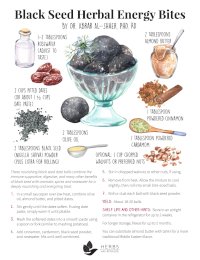
Abrar also shares her recipe for Black Seed Herbal Energy Bites—combined with warming spices and fragrant rose water, this is a deliciously nourishing way to get black seed into your diet! You can download your beautifully illustrated recipe card from the section below.
As Abrar notes, it is traditionally thought that black seed can help with almost any ailment—and if it can’t, it’s just because we haven’t figured out how to properly prepare it yet! Here are just a few ways that black seed can be worked with to benefit your health:
► Supports lung health, providing relief for coughs, bronchitis, and asthma
► Promotes cardiovascular health, including healthy cholesterol and blood pressure levels
► Topically, black seed oil helps to nourish and protect the skin
To learn even more of black seed’s benefits, be sure to check out the entire episode!
By the end of this episode, you’ll know:
► Why black seed has been revered for centuries in traditional Islamic medicine
► The many ways black seed can be prepared: mixed into honey, added to water or food, pressed into oil—or even applied by the drop into the nostrils!
► What modern research says about black seed’s role in cardiovascular and metabolic health
► How black seed can support both acute concerns, such as chest congestion or tooth pain, as well as long-term chronic health concerns like inflammation and immune resilience
► Simple, food-based ways to incorporate black seed into everyday meals
► and so much more…
For those of you who don’t know her, Dr. Abrar Al-Shaer, PhD, RD is a registered dietitian and herbalist and the owner of Precision Women’s Care, a women’s health integrative nutrition & herbal medicine practice. She is also a clinical teaching professor at Stony Brook University’s School of Medicine, where she teaches advanced case management in integrative nutrition therapy.
Dr. Abrar completed her PhD in nutritional biochemistry & immunology with a dietetic specialization in high-risk OBGYN. With over a decade of experience as an herbalist, she frequently weaves together her herbal medicine and medical nutrition backgrounds to provide patients the highest quality of care.
I can’t wait to share our conversation with you today!
Click here to access the audio-only page.
-- TIMESTAMPS -- for How to Use Black Seed
- 00:26 - Intro to Abrar Al-Shaer + her plant path
- 13:27 - Black seed in Palestinian culture
- 18:15 - The importance of building relationship with plants
- 22:22 - Home remedies with black seed
- 26:19 - Black seed oil benefits
- 28:56 - Traditional uses and preparations for black seed
- 40:54 - Scientific research on black seed
- 46:22 - Black Seed Herbal Energy Bites recipe
- 52:05 - Growing black seed
- 55:29 - Abrar’s current herbal projects
- 1:05:26 - How herbs instill hope in Abrar
- 1:16:48 - Student spotlight
- 1:18:15 - Herbal tidbit
Get Your Free Recipe!
i
Connect with Abrar
- Website | PrecisionWomensCare.com
- Instagram | @precision.womens.care
Transcript of the 'How to Use Black Seed' Video
Welcome to the Herbs with Rosalee Podcast, a show exploring how herbs heal as medicine, as food, and through connecting with the living world around you.
Black seed, Nigella sativa, is often credited with 1,001 uses from supporting the heart to digestion, to tending the lungs, and with all that fanfare, it can be easy to wonder what’s real and what’s hype. But the truth is this is one of the most revered herbs in the world. That’s why I was especially thrilled when Abrar Al-Shaer chose black seed as her plant for the show. She generously shares her family stories and traditions, ancient Islamic teachings, modern research, and the deep meaning that this herb holds for her as part of the Palestinian diaspora. It was truly an honor to host this conversation with Abrar, and I know you’re going to leave with an even greater appreciation for this small but mighty seed.
And hey, if you enjoy this episode, please give it a thumbs up so more plant lovers can find us, and be sure to stay tuned to the very end for your herbal tidbit.
Tired of herbal overwhelm?
I got you!
I’ll send you clear, trusted tips and recipes—right to your inbox each week.
I look forward to welcoming you to our herbal community! Know that your information is safely hidden behind a patch of stinging nettle. I never sell your information and you can easily unsubscribe at any time.
Rosalee de la Forêt:
Abrar, I am delighted to have you on the show. Thank you so much for being here.
Abrar Al-Shaer:
Thank you so much for having me, I appreciate it.
Rosalee de la Forêt:
It was such a delight to meet you last year, well over a year ago in Michigan in person for the first time, and get to hear your story, and then I felt like I was chasing you for a long time because I messaged you on LinkedIn, and then I forgot about LinkedIn. Anyway, and then I got to meet you again in Michigan this year. Shout out to Great Lakes Herb Faire. It’s amazing. It was really lovely. We had lunch together and some time together, so I’ve been really looking forward to having you on the show.
Abrar Al-Shaer:
Thank you so much and thank you for not giving up on finding me. I appreciate it.
Rosalee de la Forêt:
I think it was my fault. I’m so glad. It’s really been a long time coming.
Abrar Al-Shaer:
Thank you so much for putting us together. I appreciate it.
Rosalee de la Forêt:
I’m really looking forward to this conversation and really looking forward to hearing about your plant path, and all the different ways the plants have called you into—into all that you do today.
Abrar Al-Shaer:
Thank you so much for asking. I always usually like to—I have a really strong core memory from childhood that I would say is like the strongest starting point. In my family, my grandma and mother practiced, I guess you could say “home herbalism,” although they would just call it “medicine.” Whenever we got sick, they would rub herbal oils on our chests and give us sage tea. There was always a remedy for nearly everything. I remember specifically in sixth or seventh grade, we were tasked to do an herb fair—not herb fair, a science fair project. I wish it was an herb fair.
Rosalee de la Forêt:
That’s a nice slip there!
Abrar Al-Shaer:
I know, yeah. I hadn’t much—thought much about herbs, honestly, until I was really stuck on what to do for my science fair project. I knew I liked science, but was like, “I don’t know what I want to do for my project” so I went to the room my mom was sitting in. She was reading a book on the medicinal plants—or medicinal properties of olives and olive leaf, to be specific. She would always engross herself in those types of books and things like that, but I hadn't thought much of it until in that moment. I was like, “Why do you keep reading those books?” She was like, “Because plants are the origin of all healing, so if we can understand them, we can—we don’t need all these medications that you see in the market.” I remember when she said that, I was like, “Wow! Is that the original medicine?” and that was kind of my first thought. I told her, “I know what I want to do for my science fair project,” and just ran out of the room. From there, I told my teacher, I was like, “I want to do something with herbs for my science fair project.” I thought it was just so cool that you can pick something from the kitchen or from outside, and it can have healing power.
I decided at that time to actually pick black seed as my plant of choice for my middle school project—which is, funny enough, because it’s also the topic of today—because growing up, it was the most revered plant in our household. My grandmother, my mother, community leaders, nearly anyone in the community, if you mentioned black seed, it was very well-known as—we call it in Arabic, “Habbat al-Barakah” or the “seed of blessings.” It comes with a very big reverence and honor to be able to use it as an herbal medicine. I thought there must be a reason why everyone was obsessed with this plant, so I’m going to use it for my science fair project. Funny enough, I don’t know why I thought about culturing E. coli, but that was what I chose to do. I cultured E. coli. I butchered it. I did not know what I was doing, but I cultured E. coli and I put some black seed oil drops in there to test its efficacy at killing bacteria. I was so excited. Granted, I think I totally contaminated my culturing techniques. Funny enough, fast forward into undergrad, I actually decided to repeat this experiment with proper culturing techniques and actual skills. That was really fun to be able to do because we also had the choice to do a semester-long kind of experiment for one of my courses. I said, “You know what? Let me replicate my middle school project, but do it correctly this time.” Funny enough, actually, in my experiment, it was able to show that black seed was very effective at reducing populations of ampicillin-resistant E. coli strains. That was a fun project I did.
Rosalee de la Forêt:
I love that your younger self inspired your older self to continue on the same project. That’s like a successful science fair, planting the seed, planting the nigella.
Abrar Al-Shaer:
Literally. Exactly, exactly. Ever since then, any project opportunity I got in any course science-related, I would choose black seed, actually, as my point of topic. I just was always so fascinated at how much literature there was in the Islamic medicine area on this plant. I just always wanted to understand more about it. I would say my obsession started from middle school, and I, then—I remember in high school, actually, that’s when I found out about you, and John from LearningHerbs, and started learning about herbalism through your postings and websites, that would be learningherbs.com and Aviva Romm, and some of these other big names in the space. Kind of self-studied during high school and took online courses and things of that sort. Whenever we went to a bookstore, I would beg my mom to buy me all the herb books.
Rosalee de la Forêt:
Did she love that though?
Abrar Al-Shaer:
She loved it, yes, yes. She was my funder in the background. Whenever I wanted to buy a class, it would always be like the holiday gift would be her paying for the tuition for the online herb class or something like that. She was a huge supporter and big fan of it. She loved so much that I was into this.
In undergrad, I didn’t actually study something that was herbal-related because my—others in the—I guess you could say “college mentoring circles,” would be like, “Oh, that’s not a career path. You can’t do that. What, are you going to make money with herbs? That doesn’t make any sense.” I actually studied genomics—bioinformatics and genomics for undergrad, which felt left field. It was still very helpful as a science, but I hated it. I did not enjoy at all the study of genomics, and especially, bioinformatics. It’s very analytical and my brain is not a very mathematical type of person. Then, I remember I had like an existential crisis, basically, like junior year of undergrad. During this whole time, I’m still studying herbs on the side for fun because I just love it. Every single winter break, summer break I got from school, I would immerse myself in herbalism. It felt like I was living a double life, like I had this official degree life and the herbal life. It just felt so disingenuous, as if I wasn’t actually doing what my soul wanted me to do. I remember I was crying to my mom junior year of undergrad and I was telling her, “I hate this. I hate my life. I just want herbs to be my thing.” She was like, “Well, why don’t you switch in grad school? Grad school can be a way for you to pivot careers.” She was like, “How about we look for grad school programs that are the most adjacent to herbal medicine?” So then, we thought of nutrition and that’s actually why I pivoted into a PhD in nutrition. Honestly, I had no idea what I was going to do with nutrition. I didn’t even know that registered dietitians existed, and here I am, I’m a registered dietitian. I literally just went down that path because I was like, nutrition is the foundation of herbalism. Herbalism and nutrition go hand-in-hand, so if I can understand that, it brings me one step closer to what I really want to do. And here I am.
Rosalee de la Forêt:
Any regrets, Abrar, doing the nutrition?
Abrar Al-Shaer:
Not at all. No. I’m really grateful because it really, really helps to integrate the herbalism into lifestyle and not just it being like a—something in addition, but rather it blends so well with nutrition. I mean, so many culinary—or so many herbs can be used in culinary purposes medicinally. I think the treatment plans that I formulate for my patients are so much more effective because I have such a strong nutrition like physiology understanding. The herbal medicine meshes so well with that, so I’m really glad I did end up doing it that way but it was a very windy road to get there.
Rosalee de la Forêt:
The nutrition, I just think that is such a powerful combination there. It’s like anybody who is listening knows probably food as medicine is one of my biggest passions too because I love how much herbs we can actually get in food. We make it enjoyable. We make it a tradition. We make it connected to our ancestry, to our families, to our seasons. It has so many layers of meaning, which means to me that it can be so many layers of healing as well.
Abrar Al-Shaer:
Yes.
Rosalee de la Forêt:
This is way more exci—I mean, I take capsules everyday. I’m not going to pooh pooh capsules, but there’s a big difference between throwing back some capsules and sitting down to a meal that’s just complete nourishment that has so much meaning to it.
Abrar Al-Shaer:
Yeah, and the capsules can’t replace the nutrition foundation. They can only augment it. And me too—love my capsules as well, but they can only hold so much weight. They can’t be the foundation. That’s where understanding how to build and how to help people build a strong foundation I think is really powerful, for sure.
Rosalee de la Forêt:
Absolutely. I’m glad that the path—I’m glad the plants called you in such a strong way—they just kept calling to you—and I love that you had your mom as a funder and an inspiration as well. That’s really beautiful.
Abrar Al-Shaer:
Thank you so much. I think—I remembered also one small, little thing too, an integral part to this whole journey, is that around that same time during undergrad when I was really questioning what I was doing, my—I visited my grandmother overseas. She—I asked her whether she remembered herbal history in her family lineage. I don’t know why I never thought of asking that before, but at the time, she was like, “Oh, yeah, your great, great grandma. She was the herbalist of the village in Palestine.”
Rosalee de la Forêt:
Oh, wow.
Abrar Al-Shaer:
I was like, “What?” She went on to tell me stories about how she used to treat parasitic infections and how she used to help women with birthing. It seemed like she played an herbalist midwife type of combo role, and so that was really also—like it’s in my bloodline. I must do it now! That was also very inspiring to hear that story from her.
Rosalee de la Forêt:
That is—that’s like the dream I think all of us want to believe and probably is true for all of us. No matter how many generations we have to go back that there’s our great, great grandmother, perhaps grandfather, who’s the healer and herbalist. We all have it in us somewhere, but to get that connection and hear about it is really special.
Abrar Al-Shaer:
For sure.
Rosalee de la Forêt:
I feel like my knowledge of black seed is that—I mean, when you read about it, it’s just like superlative after superlative, and just how amazing this plant is. Like you said, it’s really revered, and so I was really excited that you chose the plant. I’m curious just because you’ve already touched on this, of how that reflects in your—I guess you’ve already kind of talked on this—how it reflects to your ancestry? I’m imagining that it might be a connection for the diaspora to have this plant that goes back for generations, and is so much a part of the culture. I’m curious about that. I’m sure we’re going to get into all the benefits and gifts. I’m kind of curious about that for you.
Abrar Al-Shaer:
Thank you so much for bringing that up because it truly is. I love the quote about it from—and I pulled it up here—from the traditional Islamic medicine text, where specifically it says, “Use the black seed because it contains a cure for every type of ailment except for death.” It’s such a—I think when I read that, it really brings on the notion of very strong resilience, and the reason being is because—and this is a belief that we believe very strongly not just in Islamic medicine, but also where it’s traditionally grown in Palestine, and of course, it grows in many other regions too—in Palestinian culture, especially that we mix it heavily with foods. There’s a town in Palestine named “Nablus.” There’s a type of cheese called “Nablus cheese.” The whole—main characteristic of it is that it’s mixed with black seed. It’s like freckled with black seeds in the cheese. Kind of the common or strong belief that we all have with black seed is that if it doesn’t work for an ailment, it’s because we haven’t figured it out yet. The plants can do it. We just haven’t figured out how to get the plant to—how to figure out how to use it in a way that it’s going to be useful for that ailment. I think that is such a testament to the Palestinian spirit as well – to keep trying and keep persevering, and no matter how many obstacles are in our way, we just keep figuring it out, keep trying, and keep resisting the erasure of our land, and our heritage and our culture.
Black seed being—even the mentality of how to use black seed and that it never will fail you no matter how hard, as long as you keep trying, I think is a testament to the environment it grows in and the people that revere it.
Rosalee de la Forêt:
That’s beautiful.
Abrar Al-Shaer:
I think it’s a way to keep—thank you so much. It’s a way to keep connecting also to the land that it’s—that we’ve been kicked out of. I think that I will never forget when I visited my grandmother in Saudi Arabia because she was—she was first born and raised in Jaffa, which is next to Jerusalem, and then she was kicked out to Gaza, and then kicked out to Saudi Arabia. I remember—I remember this hot desert, very different topography than Palestine. Very different. Palestine is very similar to California weather and topography. You’ll find just like how in California and the West Coast you’ll find orange trees and pomegranate trees just growing everywhere. It’s the same thing in Palestine, but in Saudi Arabia, absolutely not. It’s palm trees and that’s it. You don’t really find much else. When I visited her in Saudi Arabia, I remember explicitly how—I was amazed that she, by some miracle—I don’t know how she did this—was able to grow so many of the Palestinian plants and herbs in Saudi Arabia, in the desert. I was like, “Grandma, how on earth are you—how did you a grow pomegranate tree and a fig tree in a desert? How are you able to grow some black seed flowers in the desert?” Again, I think just a testament to you can’t ever take the land out of the people even if you take the people out of the land. The diaspora hold it very dear and near to their hearts, especially this plant.
Rosalee de la Forêt:
I feel like it’s one of the most revered plants. I think of tulsi being that way. I think of reishi being that way. In some ways, I think of dandelion being that way, but black seed just feels up there. There’s something about it. Not that it’s better or worse than any other plants. I don’t want the other plants to take offense, but there’s something about it that really holds a very strong force within it.
Abrar Al-Shaer:
Exactly. I even recall another story that really speaks to, I think how—how strongly black seed is felt as a not just medicinal, healing plant, but also it’s like a spiritual connection too. My mother actually used to always tell us of the story because she felt it was such a cool, miraculous story, where she, after giving birth to my second or third sister, she had this overgrowth—skin overgrowth that was painful and sensitive to the touch, like on her thigh. She said how the doctor said she has to get it surgically removed. They didn’t know exactly what it was. She was so really afraid of having surgery. She really didn’t want to go down that route, so she spent the next two months in between that time and her surgery date, everyday boiling black seeds and putting a cotton ball and applying it to that area multiple times a day every day until it eventually shrunk. It’s amazing. It completely went away. She never needed to do the surgery, but she doesn’t attribute that to just the medicinal properties of black seed. She always will say, “That was because spiritually I knew black seed would help me.” And I think there’s—yeah, there’s a difference between just ascribing it as a medication, versus knowing inside of you that this plant is a part of you, and you are a part of it. It’s going to do what it needs—needs to do for you.
Rosalee de la Forêt:
I love that so much, Abrar, because that’s speaking to the relationship with the plants—this reciprocal relationship. That’s what I think a beautiful transformation I felt myself within herbalism. I began studying herbalism as like “herbs as drugs” in a sense. Just like, “Okay, I’m going to take this thing and it’s going to make me feel this way. It’s going to make me better,” which is—and sometimes that does happen. You can take ginger and feel less nauseous. It’s not like that never happens, but to enter into that relationship where you’re—believe in the plants. You are tending the plants. You’re working with the plants in a way that you just—you can’t help but form an intimacy with them because you’re smelling them. You’re tasting them. You’re taking them. You’re relying on them. That’s a very powerful shift. That story really illustrates that relationship.
Abrar Al-Shaer:
Exactly, exactly. I think that I was really lucky to have seen that example growing up. I think I’ve always seen plants as they are—even religiously. We grew up with “these are gifts that God has given you” to learn from, not just to use, not just take from the land and distribute for your own gain, but to actually observe and learn and take lessons from how the plants are grown, and how they help you in your body, and that they wouldn’t—they don’t help you unless you have that connection spiritually and that belief that they were made to do that.
Rosalee de la Forêt:
They are living beings.
Abrar Al-Shaer:
Exactly, yeah.
Rosalee de la Forêt:
Hey, it’s Rosalee. You know, creating this podcast has been one of the most rewarding parts of my herbal work, and if you found something meaningful here, whether it’s a new perspective, a favorite recipe or just a sense of calm, I want to let you know there’s a good way to go even deeper. It’s called the “Podcast Circle.” Inside you’ll get access to live classes taught by some of my favorite herbal teachers, behind-the-scenes updates, and a beautiful library of herbal resources that we’ve gathered over the years. But more than that, it’s a space to connect with fellow plant lovers who care about the same things you do. And truly, your membership helps make this podcast possible. It’s how we keep the episodes coming and the herbal goodness flowing. So, if you’re ready to be part of something more, something rooted in connection, head over to HerbalPodcastCircle.com. I’d love to see you there.
I’d love to dive into black seed and wherever you want to go next in terms of maybe how you work with it or things that stand out with you with the medicinal aspects of black seed.
Abrar Al-Shaer:
I’ll mention a couple home remedy uses that we grew up with, and then I’ll shift into what actually Islamic medicine traditionally from thousands of years ago what the original uses were, and then into the research uses.
Rosalee de la Forêt:
Alright!
Abrar Al-Shaer:
Maybe that will be the nicest way to cover it.
Rosalee de la Forêt:
I feel like I could get some popcorn—
Abrar Al-Shaer:
If I’m talking too long though, feel free to let me know.
Rosalee de la Forêt:
Oh, no. I am so excited.
Abrar Al-Shaer:
Okay, it sounds great. The reason why I like the date recipe is because that’s actually often times, especially as kids, having herbs mixed with date paste or herbs mixed with honey is one of the most common traditional uses, especially for black seed because it does have a little bit of—a little bit of bitterness, especially for younger ones that they don’t really enjoy. Often times, I recall my family members, especially my mother and grandmother, they would—if they wanted to quickly have a medicinal dose of it, especially if there was a cough, bronchitis is a main one that I remember them using it for often and giving it to us—they would grind the seeds or have the powder and then they would mix it with some warmed honey, and just eat it at the spoonful.
It actually makes sense with the traditional use because a lot of the literature online says that the medicinal dose is like 2 grams, 3 grams, which is really, really small quantities, but if you dive into the original Islamic medicine literature, it’s actually 25 grams. Much, much bigger quantity, which is about 3 ½ tablespoons. For bronchitis, shortness of breath, if you want to use it for acute purposes quickly, you do larger boluses of the powder mixed in, usually with honey.
Sometimes you’ll find, especially in Middle Eastern markets, even here in the US, if you walk in, you’ll find what they call “black seed paste.” That typically is black seed powder mixed in with tahini, usually, or tahini and honey, or tahini and black seed oil and black seed powder. You can totally make this at home, as well. It’s not that difficult. Same thing. You can—sometimes I’ve seen folks dissolve it in warm water and drink it that way, or just take it by the spoonfuls. But typically, it’s always consumed ground up and/or boiled. You don’t just crunch the seeds, which makes sense. They’re pretty hard and you can’t really extract much if you just take it that way.
I think coughs and bronchitis and shortness of breath and asthma, kind of the main things growing up using it. Also, skin manifestations, like the story I mentioned with my mom, or even when my younger sister had eczema. I’m not sure if there’s—well, there’s probably research. There’s every type of research article on black seed, but I’m not sure how strong the research is on eczema and black seed. She would rub the oil on her eczema, for example, as a moisturizer as well. Again, also with the spiritual intent of this is a revered plant that God has told us that is revered and to honor it. Therefore, by that, I spiritually believe it will heal the eczema. That’s also a big part of its traditional use. I think it’s important not to tease that apart. Those are the main things growing up. Now, in terms of-
Rosalee de la Forêt:
I have a question, if you don’t mind, about the black seed oil. Black seed oil, that’s like a cold press oil similar to rose hip seed oil.
Abrar Al-Shaer:
Yes, yes, exactly. I actually saw them make it once in the mark—I think it was a market in Turkey that I saw them actually make it in front of me. It’s cold pressed exactly like that. There’s like a machine that will cold press the seeds, and then you’ll see a big, long tube of the dried seeds coming out and the oil coming out on the other side. You’ll have the crushed seeds separated from the oil, but yes, exactly.
Rosalee de la Forêt:
That would be amazing to see in the market because you get the fresh oil.
Abrar Al-Shaer:
Yes, yeah, yeah. I did buy it at the time. I was like, “Give me that oil!” It’s exactly-
Rosalee de la Forêt:
That’s—that’s—you mentioned it too that could be mixed into—did you say that might be mixed in tahini? That could be taken internally, as well as externally.
Abrar Al-Shaer:
Yes, yeah, yeah, yeah. They’re very much used interchangeably, and even in traditional literature, the ground seeds and the oil are commonly interchangeably used. There are some specific indications that I’ll mention right now where the oil is particularly used as an eardrop or nose drops, but otherwise, even in the scientific literature, it’s really fascinating they’ve found that you can replicate the efficacy with both. There is a really big meta analysis of more than 50 studies for cardiovascular disease benefits of black seed oil, looking at LDL, HDL cholesterol metrics, blood pressure. The studies had a wide variety of special extracted oils, just regular black seed cold pressed oil, just the black seed powder, a standardized extract of the powder. They all basically functioned pretty much the same. That’s the nice thing. Whatever you have access to is fine, but-
Rosalee de la Forêt:
Lovely. Thank you.
Abrar Al-Shaer:
I will add though to that that the antioxidant, one of the phytonutrients in there that’s most bioactive is called “thymoquinone.” If I’m recalling correctly, it is mostly fat-soluble, alongside with some of the omega-6s and omega-9s in the plant. I guess if someone was wanting to use it as a potent antioxidant, perhaps an oil, fat-based extraction could help more. You could make the argument that maybe you could take it like Vitamin D where you just have to take it with a fat-soluble meal, then the powder would be fine as well. I think that either way would probably work.
That’s from the basic starting points. Some of the other interesting traditional uses that are interestingly more acute, and then a lot of the research literature is more for chronic conditions. I thought that was a nice difference there that we can learn from. Black seed is hot and dry. It is pretty strongly hot and dry. In Islamic medicine, it’s categorized hot and dry to the third degree. There’s like—they kind of categorize it as degrees of strength of the energetics. Interestingly, it’s mentioned that you could combine it even though it’s hot and dry, but if someone has a cold, even if it is manifesting with hot symptoms, but if you combine a small amount of the black seed with other herbs, you can use that as a synergist to deliver the herbs more effectively. Kind of like ginger.
Rosalee de la Forêt:
Ginger. Yeah, ginger. That’s exactly what came to mind.
Abrar Al-Shaer:
Yes, yes. I thought that was really interesting. That’s a common, traditional use of it as well. It’s recommended when you do that, it’s smaller dosages, not the 25 grams. And then also, it is often recommended for colic, gas, for—interestingly for intestinal parasites. It’s combined with—it’s boiled with vinegar then used as a compress actually topically. I thought that was really interesting, but classically would be mentioned to use when there’s excess moisture of the stomach or basically, I guess lots of secretions that you can ingest black seed ground with honey and warm water to help with that. Interestingly, the ground—the ground black seed with honey and warm water was also traditionally documented for use of kidney and prostate stones as well. To break those apart, and it specifically quotes, “dissolves the stones that appear in the kidney and the prostate, and is diuretic as well.” By the way, to mention as well what am I quoting from, this book here, Medicine of the Prophet. It’s a very old, very classic Islamic medicine text. It actually was authored in the 1300s.
Rosalee de la Forêt:
Wow!
Abrar Al-Shaer:
Ibn Al-Qayyim is a very—he’s the author of this book. It was originally in Arabic. This is the English translation, but I also have the original Arabic text next to me here. He was an Islamic scholar of religion and theology and whatnot, and also an Islamic medicine scholar. He did both. He authored this book, basically, at the time, in the 1300s, there wasn’t one publication that summarized Islamic medicine very well. That was basically his goal by putting this all together was to combine all the literature into one. It became a timeless piece for sure. When I’m quoting, that’s where I’m quoting from, specifically. By the way, this is free PDF online, very easy to find.
Rosalee de la Forêt:
Oh, cool. I’m already really into looking that up, so thank you for that tip too.
Abrar Al-Shaer:
Of course, I thought it’s also really interesting on how flexible its usage is. I think also, that’s what I’ve seen with my family and how they use it too, whether it would be rubbing it topically, boiling and putting in little pad and applying it to the skin, or ingesting it. There are so many different ways that it’s used. That’s also how it’s outlined in the text here because even for—for example, they mentioned if you have a lot of cold symptoms with congestion, it’s recommended that you put a rag infused in black seed water, and then you inhale it, interestingly. I think that was also very interesting, and doing that, they said, on a regular basis will, “the ailment of the cold will be cured,” is how it’s phrased.
The oil was also mentioned for using on skin manifestations like hemorrhoids or ulcers, and spots, very generic, but basically, I guess overgrowths. It’s also mentioned that for asthma, specifically—going back to bronchitis, this is what I thought was interesting because it matched what my grandmother and mother used to do—it says that you must use 25 grams and it has to be drunk with warm water. You can add honey if you want, and that will help with the immediate sense of if someone’s gasping, and they’re just hungry for air, and they’re just not able to find the air. It’s a fast remedy to help with that if at least, you have to reach that 25-gram dose. That was emphasized a lot like, “You have to reach the dose for that to work.”
I think that, yeah, the topic of cold, colds, asthma, allergies comes up a lot in the text. Specifically, this actually was mentioned in this text, and this one that’s, unfortunately, not in English, but they both mention here that black seed is particularly helpful for conditions with lots of sneezing. So, if you’re sneezing profusely, yes, whether it be a cold or allergies-related sneezing, they mentioned that. It’s a very interesting preparation though. It’s not the same as the rest. They said that you have to fry it. You have to fry the seeds first, then you grind the seeds, and then you soak them in oil. I guess for extra benefit, you can soak them in black seed oil, and then you apply three drops into each nostril in the nose, and that should stop the sneezing. Specific amount of black seeds because in this book, it doesn’t say how much black seed per oil, so then I reference the—this other book that’s in Arabic for that. They mention that the original story by which this was done about 1,400 years ago, was they took about five to seven black seeds and did this frying, grinding. It’s not that much. It’s a small quantity, but they used that whole quantity to then put in a small droplet of oil, and put up the nose. That was interesting. I saw that kind of replicated in multiple classical texts.
Rosalee de la Forêt:
I’m fascinated about that.
Abrar Al-Shaer:
I know. I was sneezing so much this morning. I was like, I need—I’m going to do this today. I will let you know because I didn’t—it escaped me, I guess the sneezing piece. I never even recognized that that strongly until I went back to review some of the older literature. I was like, sneezing, that’s interesting.
And then lastly, I think, also interestingly that another common preparation is with vinegar. You find that not much in the research literature, but it is very often mentioned in the traditional literature where they say you can cook the black seeds in vinegar, and then you can use it as a mouthwash to stop cold sensitivity to your teeth. I thought that was really interesting and for toothache—but specifically, toothaches related to cold sensitivity. And then, I also—it was mentioned that that same preparation with the vinegar can be used for exposed ulcers on the skin to heal those up as well, and to also decompose mucus tumors and hard tumors. But, of course, it’s a bit general. I’m not recommending that someone use this as a sole cancer treatment, but basically, benign overgrowths it seems was helpful for, as well, which is interesting, kind of what my mom's story was about as well. I felt that was really interesting.
The other fascinating piece was it also was used for facial paralysis. The black seed oil applied in the nose, actually, was used for facial paralysis.
Rosalee de la Forêt:
Like Bell's palsy or maybe a stroke.
Abrar Al-Shaer:
Yeah, exactly. They didn’t mention at the time, obviously, this is early 1300s, what related, what specific facial paralysis, but yes, I think that definitely—given how harmless it is, I just feel like, why not? No one will have any interaction or issue from a few drops of black seed oil into your nose. I just thought that it was so interesting because the nose application was mentioned so many times, whether it be for the paralysis or the intensive sneezing, or even the inhaling it with the rag for the cold symptoms, and the congestion. There seems to definitely be a wisdom behind the application into the nasal cavity with black seed, so I thought that was interesting as well. But, yeah, those are the main things. There are some other random very interesting stories like application with rabies and whatnot, but I think we have better medications for those now.
Rosalee de la Forêt:
Good call, good call.
Abrar Al-Shaer:
Yes, yes.
Rosalee de la Forêt:
Oh, my gosh, so—so this is Islamic medicine. We’re looking back hundreds of years. We’re also thinking about your family and how you’ve seen it used traditionally in your family. My takeaway is really like a lot for the coughs, congestion, lungs, but also for skin, for overgrowths, and then this—all this smattering of things like for kidney stones, digestion. I love that you had the energetic specifics on that, then for even oral health, and then putting it on the nose for sneezing. I really want to remember this in the future, and other applications too. The nostrils—it sounds very fascinating. I’m telling you I’ve always known this about black seed. It just feels like there’s so much under the sun that people reach for black seed for.
Abrar Al-Shaer:
So much, so much. Whenever someone asks me, “Hey, does black seed help with this?” I’m like, “Probably.” We can probably find some sort of study. Because also since it’s so revered in Islamic medicine, a lot of universities in the Middle East have put a lot of research funding into it as well. Often times when you open PubMed studies on black seed, you’ll be like, “How on earth did this one plant get this much research funds?” and it’s because of its traditional history there, and its reverence, and its spiritual—it’s almost looked at as like a—as a—like a pious, spiritual act to research this plant. That’s also kind of a big motivation why much of the Islamic countries put resources into researching this plant, but-
Rosalee de la Forêt:
It makes me think of turmeric; turmeric kind of being similar. It’s just this highly-studied plant that’s also highly-revered, also people reach for that for many different things as well.
Abrar Al-Shaer:
Yeah, exactly.
Rosalee de la Forêt:
I actually wonder if those are the two most researched herbs.
Abrar Al-Shaer:
Probably, honestly.
Rosalee de la Forêt:
I kind of want to look into that. I’m not saying they are, but it wouldn’t surprise me if those were our two most researched herbs. I feel like they’re like this, and then the next tier is like down here.
Abrar Al-Shaer:
Yeah, exactly. Huge, huge. Yeah, exactly. Which brings me to the research literature if you wanted me to mention that.
Rosalee de la Forêt:
Yes, yes. For chronic disease, which I think is fascinating.
Abrar Al-Shaer:
Exactly, yeah, yeah. Specifically, in the chronic disease realm, it’s the highest grade evidence. Of course, like I said, there are thousands of studies. You can find a study for almost anything, but I’m pulling on what studies have replicated the most similar results. Looking at the chronic disease area, the ones that have converged to the highest efficacy outcomes with black seed have been cardiovascular disease outcomes. So, a wide variety of cardiovascular disease outcomes, so a lot of the cholesterol metrics that I mentioned earlier, blood pressure, even inflammation of the blood vessels, which is really interesting, Type 2 diabetes, hemoglobin A1c, reducing that. All of those have pretty strong research data of black seed benefits. Weight support, of course, again, it’s not a weight loss pill on its own. “No pill without a skill,” as I like to say. In combination with nutrition—
Rosalee de la Forêt:
[crosstalk] nutritionist.
Abrar Al-Shaer:
Yes, yes. It can be really helpful too. For those, the doses really mostly stand between 1,000 mg to 3,000 mg or 1 gram to 3 grams, so much less than the 25-gram. I think for acute purposes, the 25 grams makes sense. You don’t have to go that far for Type 2 diabetes or cholesterol support or blood pressure support because the research is pretty good at this—these smaller doses. We don’t want to be wasting the plant if it’s not necessary, obviously. The 2 grams, interestingly, was shown to be effective, like I said, with both oil and powder; either one is fine.
Oh, yeah. Allergy symptoms was actually also another highly-researched effective outcome. They looked at it in multiple contexts and in conjunction with allergy medications alone. They found it to be also efficacious in similar dosing, around 2 grams. From my clinical experience, in the practice, we’ve used it in that context a lot too. The primary context we’ve used black seed has been asthma, allergies or—specifically, allergies with asthma. I think allergies with bronchitis is typically what I think of. I don’t usually go for it strictly for allergies alone, and then high blood pressure. Even in my patients who don’t have high blood pressure. I remember we once had a patient who we wanted to use it for asthma, and then her blood pressure got too low when she used the black seed, which I wouldn’t say is necessarily common, but some people, I guess who are ultrasensitive can have that response. So, we combined the black seed with licorice and that balanced it out for her, that’s what we ended up doing. And it’s often a great one, I think, for anyone who is struggling with pre-diabetes, Type 2 diabetes, cholesterol, because we know that all these chronic metabolic conditions are inflammatory in nature. They don’t just—it’s not like you just have high cholesterol. The elevated cholesterol activates your immune system. It causes a chronic inflammatory reaction, as well. When you have pre-diabetes or diabetes, higher blood sugar, even if you don’t have those yet, but you have higher blood sugar numbers on average, you know that that’s constantly eroding. I tell people it’s like if I put syrup down your bathroom pipes, it’s going to erode and rust, the structure of the pipes, and similarly, with your own blood vessels too. Given that black seed is such a strong antioxidant as well, I think that there’s a lot of preventative support that can be used for that. Two grams is nothing. It’s like a fourth of a teaspoon or something like that, so you can easily sprinkle that on a salad, put that into your oatmeal, put that into your smoothie. It’s so easy to integrate also as a food, not just a capsule.
Rosalee de la Forêt:
That was actually my next question. I was wondering—just hearing you speak about it—there are herbs for me, because heart disease is so rampant and so many—it’s the #1 cause of death in this society, just the whole metabolic disease and inflammatory, all this stuff is just so rampant that I’m often thinking how can people just start welcoming plants into their lives as obviously, there’s nutrition, there’s movement. There’s many things to consider, sleep, etc., but how can we just welcome things into our lives joyfully. For me, I think about hawthorn. That’s an obvious one. I think about turmeric. I think about tulsi. All the herbs really have such a wonderful effect. I’m wondering that about black seed. Because as you speak about it, I was thinking like in the mornings we have—we often have this curried veggie eggs scramble. We put cumin and fennel and all sorts of herbs in there. There goes our—you know, I could put a half teaspoon of black seed in there, no problem.
Abrar Al-Shaer:
Yeah, very easy to do.
Rosalee de la Forêt:
Delicious, preventive, joyful.
Abrar Al-Shaer:
Exactly, and it kind of has a pungent aroma which is—it works really well in savory type of dishes. Even in the date ball recipe I combine it with cardamom.
Rosalee de la Forêt:
Let’s talk about that. Let’s talk about your date recipe because this sounds so lovely. Would you just walk us through that? For anyone listening or watching, you can download your own illustrated recipe card. Either check out the show notes for a link or go to herbswithrosaleepodcast.com, but I want to hear it from you, Abrar.
Abrar Al-Shaer:
Thank you. This is more so inspired from how my grandmother and mother would administer black seed to us, especially as kids. Like I said, often times we’d combine the powder with date paste or honey. Obviously, if you’re diabetic or you struggle with blood sugar, maybe a modified version of this would be best, where instead of dates, you could do tahini paste instead, excellent source of unsaturated fats that is wonderful, also cardiovascular disease prevention. You can totally play around with this recipe, make it more of a tahini paste inspired one. The almond butter and the olive oil in the recipe are meant to give the date paste less of a sticky and more of a smooth silky nature. Often times with many Arab date desserts, you will find an oil is integrated into the date paste always to make it more silky, and that makes it very buttery-tasting almost, and delicious. Then, the black seed, like I said, it kind of has, at least to me, there’s a little bit of bitterness aftertaste to it, so I do really like it with other pungent aromatics like cinnamon and cardamom. Often times in traditional Arab desserts, it’s mixed in with these spices or other similar spices like cloves. You can replace them for other spices that you wish. It doesn’t have to be cinnamon and cardamom, but I think the nice thing is also cinnamon does also have blood sugar lowering effects, so maybe the dates may not be a great idea—instead doing the tahini there. That’s the idea behind the combination with the other spices as well. I love rose water in desserts. I put it there as an optional if someone doesn’t like it, but I think that it’s a classic. A lot of Palestinian and other Arab desserts are classically given rose water scent or rose water taste to them, so it wouldn’t be the same without the rose water.
Rosalee de la Forêt:
Definitely do the rose water, folks. It jumped—I already talked to you about it. It jumped out at me. It was like, “Ooh.”
Abrar Al-Shaer:
Yes, yes.
Rosalee de la Forêt:
Lovely.
Abrar Al-Shaer:
It elevates it and makes it just so delicious, like pungent—it’s like pungent, floral, all the different mixtures together. I do really like mixing it with nuts as well. It becomes really nutritious too. I think that this is such a wonderful recipe also for someone who might be recovering from a cold or infection, easy way to get nutrition. It’s medicinal and you can up the quantity of the black seed powder totally to match more the higher level dosing, in replacement of the other powders instead. You can totally play around with this. The nice thing is you can’t really mess it up. If you put a little too much powder, just add a little more date paste. You can’t really go wrong. I think that because it packs such a nutritional punch as well, especially if you combine it with nuts and the dates. If you want it to be a little more protein-packed, you can use almonds instead of walnuts, that way you will get an energy boost. Let’s say, you’re working a shift or you’re—you want something as a quick snack because you’re hiking and you need a carb, this can be a really nice thing to have in your pouch.
Rosalee de la Forêt:
I love it as a hiking trip snack. That’s lovely.
Abrar Al-Shaer:
Yeah, it would be very yummy. Often times, my mother would pack these as treats-on-the-go. I think they’re such a wonderful activity for kiddos to do with them because it’s a wonderful way to—it feels like you’re eating candy as a kid, honestly. It doesn’t feel like anything else. You don’t—you don’t think about the medicinal properties as a child, but it can be such a wonderful way to incorporate kids with herbal medicine. I remember between me and my youngest sister, there’s a 14-year age gap. It kind of felt like I raised her a little bit too. When I was in my herbal journey in high school, she was six years old or so. I often—she would be really intrigued, like what am I doing in the kitchen? Mixing some herbs and making some balls or pastes or whatnot. I often would tell her, “Come do it with me.” Until this day, she loves taking herbs because it reminds her of the fun she had with her sister growing up. I think those core memories and bonds can also be beautiful to do, and very nutritious, and can replace the sour patches.
Rosalee de la Forêt:
Right, right. My dear family friends, they are farmers. They prefer their kids to get their sweets through foods. They’re going to love this recipe.
Abrar Al-Shaer:
Yes, yes. That sounds great.
Rosalee de la Forêt:
I’m excited to hear what people feel or people get from this recipe – the deliciousness, the healing, nutrition. So, when you make the recipe, please let us know in the comments and share your experience. Sometimes people sharing their experience is what then inspires someone else to actually give the recipe a try, so please do.
Abrar, this has been fabulous, sharing all this about Nigella, black seed. I have a question for you. I—in my younger herbal years, I thought that love-in-a-mist, the plant, love-in-a-mist, was black seed, and it’s not. It’s a similar but different species. I would grow it and it’s such a beautiful flower. It’s so much fun, but I don’t think I have actually any experience growing—specifically growing black seed. Do you? Do you grow it?
Abrar Al-Shaer:
I really want to. I honestly haven’t. I just recently relocated to California. It’s temporarily—yeah, temporary move, so now I can try, finally. I was always in either the harsh winters of Chicago or Pennsylvania. I was in North Carolina for a hot minute during my schooling, but I was so engrossed in my schooling. I have found it in botanical gardens and I have taken many pictures with it because I love it, but unfortunately, I am not a grower of it yet, but definitely, I have some of the seeds for growing here in the cabinet and it’s on my bucket list to start trying to do soon.
Rosalee de la Forêt:
That’s fun. Maybe I’ll check back in with you about that and see how it goes.
Abrar Al-Shaer:
Yes, I’d love to let you know. My grandma would probably be great to ask that question too. I should have asked her before this podcast. I’ll probably take some tips from her when I try to grow it myself.
Rosalee de la Forêt:
That will make it all the more lovely as well. Was there anything else you’d like to share about black seed before we move on?
Abrar Al-Shaer:
I think that covers most of it.
Rosalee de la Forêt:
We’ve covered a lot, so this has been really cool. I’m excited just to bring this into my life more regularly. Like I was saying, we can put it in our breakfast stir fries, put it on salads like you mentioned. I like that. Do you think we could use the oil in the salad dressing? Or is it-
Abrar Al-Shaer:
Totally. Totally, yeah.
Rosalee de la Forêt:
Like maybe [unclear] or something, mix it with olive oil.
Abrar Al-Shaer:
Yeah, yeah, yeah, for sure. Whatever—I’m not sure how much 2 grams of oil is but it’s not a lot, so even if you drizzle it that should be pretty medicinal level dose too. Since the composition of it is primarily omega-6 and omega-9s, it is more prone to oxidation, so kind of similarly to how you don’t want to overheat olive oil. I wouldn’t want to overheat black seed oil or-
Rosalee de la Forêt:
That’s good in salad, actually.
Abrar Al-Shaer:
Yes, exactly. It’s recommended to keep in a dark, cool place. Best enjoyed cold or warmed, I guess, but hot-
Rosalee de la Forêt:
And buy in small amounts. That’s also generally, my take on that too. Okay, cool. I’m really looking forward to this.
Abrar Al-Shaer:
Likewise. Here’s one random other thing I forgot to mention – it is also traditionally used as a galactagogue, so I think this recipe is amazing for breastfeeding moms because their nutrition needs are super high. This is a great nutrition-packed support that can be helpful too.
Rosalee de la Forêt:
It’s a delightful treat as well.
Abrar Al-Shaer:
Yes, yes. I’ll leave it at that.
Rosalee de la Forêt:
Wonderful. Thank you so much.
We got to hear about your path. We got to hear about going back to your science fair in sixth and seventh grade, and how that has stayed with you, and how your plant path has evolved. You went to your undergrad. You got your PhD in nutrition. Now, I feel like it’s time to go for the rest of your plant path. You have your own center that you’ve opened. You work with other people there. I would love to hear about all of that and just how you serve people now in your role as herbalist and nutritionist.
Abrar Al-Shaer:
When I was getting close to graduating from my PhD, I knew that that’s what I have to do—what I wanted to do all along. I think if you had asked me way back when to tell you what I was most passionate about, it would have been to have some sort of practicing center or something to serve the public in this way. We’re a group practice now. I used to be solo, but I, over the years, had some teammates that were likeminded join in with me. That has been really nice and rewarding, and very amazing to be able to have likeminded colleagues to also brainstorm ideas. We work very collaboratively as a team. The name of the practice is Precision Women’s Care. We are—specialize in women’s health, specifically, so I’m sorry to the guys out there. The articles and blogs that you can find on our website, precisionwomenscare.com, will be applicable to a lot of people.
Basically, the premise of the practice is we are all registered dietitians and herbalists. We do not practice them in silos or separately. Every single session of ours is a combination of the two. A big mission of mine and all of us in the practice—we’re a total team of four—is to teach people how to be their own little herbalist at home; not just give them herbs. I think that’s so important because that’s what’s missing from a medical model – being able to empower people on how to be their own healers, how to take care of themselves and their families. Instead, we want to make sure that we build a model where, okay, it’s not like provider and providee relationship only, and you just listen to whatever I tell you and go home. It’s rather we are educating.
Every session is a chance to educate, to counsel, understand how are the behaviors happening, why do you feel this way about this behavior or that, why is something such a big barrier. Not to judge, not to shame at all, ever, but to actually understand how did we get here. I often tell patients your body just doesn’t decide to stop working. Slowly builds compensation mechanisms that just aren’t serving it anymore. We need to just understand how it got to that point and figure out a way to reeducate it to a new perspective of living that is more helpful to you right now. That’s basically the whole goal of the team is to help to serve patients in that way. There’s a couple different things that we’re also working on.
In terms of serving patients and the public, we do accept insurance; not all insurances, but we do accept Blue Cross Blue Shield and Aetna insurance. That’s—I wanted to always make sure we can accept some sort of insurance because I wanted to keep that accessibility. Sadly, not all insurances have great nutrition coverage anyway, so it can’t—it doesn’t work to be in that group with all of them because some of them have ridiculous restrictions, like you must only come to us after you’ve been diabetic and have kidney disease, which is not very preventative. We have that option if someone is able—has those insurance plans. Otherwise, there’s obviously the cash pay options, and we’re flexible with payment plans and stuff like that.
Usually, our sessions are always 60 to 90 minutes long because, again, we value education, and getting you to actually understand not just how your treatment works, but how has this condition that you’re having right now manifested. I think a big part of anyone who joins the team and the practice is you have to know your biochemistry so well that you can distill it and teach it in third grade format to anybody that comes to you. I think that is true empowerment, when the patient can understand like, “Whoa! I actually get what A1C is and how it actually works, and how did it get higher, and how it resets every three months, and exactly all the intricacies that go into that.” Then they know how to tailor and change their treatment approach as time moves on because I always tell people, “You don’t want me to be a bigger crutch. You want me to be a guide that empowers you for life.” Our main kind of mission is to make sure that every session is always education. Counseling, of course, is part of our big approach – nutrition counseling and understanding that behavior change, and weaving herbs into that as a lifestyle.
Of course, we’ll use capsules when we have to, and tinctures, and things like that. We do custom formula. We work with a compounding formulary that helps to custom-formulate too for us. A big part of it is also making sure—I think the best example I can give is a story of a patient who, she came to me with a debilitating GI symptoms. They were so bad she’d be bedridden or fainting sometimes from them. Many of my teammates have seen similar—they’ve had similar cases as well. The beautiful thing is that over time, as we worked together for about a year, a year and a half, she learned how to build her own little apothecary. We would talk about how an herb can help. She’d be like, “Okay, how exactly do I use this herb? How much exactly? How much should I steep sage tea for?” I’m like, “Well, it’s okay if it goes a little bit beyond a 20-minute steep. It’s not the end of the world.
You can have it in ice cubes and have it as an iced latte instead of just a traditional hot tea. That’s also okay.” Talking about how herbs can be used and played with at home and accessibility is a really big part of what we do too; meaning, if someone can’t afford to buy a product, “Okay, I’ll just teach you how to make a tincture. That’s fine. That’s much cheaper. Let’s do it. Let’s spend this session talking about how to make a tincture. Let’s go into your kitchen. Let’s make a tincture together.” I think that really also makes it so much more accessible and not just for the privileged to be able to access these medicines.
Over time, this patient, the more and more herbs that she got to play with, and whenever she’d ask me for rigid guidelines, I’d kind of keep it loose on purpose, “Try it this way and try it that way, and see how your body responds. You are the best expert of you and you’ll be able to tell.” I think that’s what a lot of people—they’ve gone through so much fear in the medical—traditional medical model, unfortunately, of just being told what to do and not being empowered of understanding what their bodily signals and cues actually mean. Herbalism is such a beautiful way to tap back into that body intuition and that body trust, and actually learn what your body is trying to communicate with you, and then respond to it appropriately, based off of the different tools that you have, not just one. And then her whole family became mini herbalists with her. She’s totally doing this with everybody and that became very fun. They all became obsessed with calamus root, funny enough.
Rosalee de la Forêt:
Oh, interesting.
Abrar Al-Shaer:
Of all the things.
Rosalee de la Forêt:
Of all the things!
Abrar Al-Shaer:
Yeah, I know. I was like, “It’s so funny that you guys really liked that.” They all suffered with GI issues, ironically, and they found it very, very helpful. I think that’s kind of the mainstay of what we do. We are launching an initiative in 2026 where we will be offering free webinars for the public. We really—because obviously, a lot of the work we do right now is one-on-one patient care, but we want to be able to give some of that education to the audiences online, and for the public for free, for those who might not even know what the heck we do and why it’s helpful, and how powerful this can be. Starting 2026, we’ll try to—we’re trying to aim for a monthly webinar topic where we will discuss how do you actually approach treating or addressing, xyz condition using an integrative nutrition herbal medicine combination lens, and how do you actually start to become your own medicine healer at home.
Rosalee de la Forêt:
Oh, my gosh. That’s going to be fabulous. Where can people find out more about that? Is there a newsletter or follow you on Instagram? What do you prefer?
Abrar Al-Shaer:
Two places – our Instagram is precision.womens.care. Precision women’s care, but just with the dots between the words, you can find us there, and then you can also go to our website, precisionwomenscare.com. If you just scroll all the way to the bottom, there’s a newsletter sign up box and you can put your email. If you’re not on social media, totally respect that. You can put your email instead.
Rosalee de la Forêt:
Wonderful. Awesome! Thank you so much for sharing about that. Thank you to you and your whole team for all the wonderful work you do. Before you go, I do have one last question for you, Abrar.
Abrar Al-Shaer:
Yes, please.
Rosalee de la Forêt:
That question is, how do herbs instill hope in you?
Abrar Al-Shaer:
That’s a great question. I think—I think of it from two perspectives – from a clinician perspective and then kind of as a Palestinian in the diaspora perspective. I think I have the feelings of it into—in those two ways. First of all, from a clinician perspective, I can’t tell you how many times that we have seen our patients, their entire approach to life has changed from using plants and herbs, because like I was saying earlier, it has forced them to actually start to respect what’s being told inwards instead of just putting that respect outwards. I think that is so powerful, especially when it ripples to the family and extended family members, and the communities as well.
It’s really interesting. We’ve had many patients where in this—all within—there are certain—we see patients all over the US, but there are certain states, I guess, that we have more people from. They’re mostly states that I’ve lived in or my teammates have lived in before, like North Carolina, Illinois. It’s so fascinating because there are little community hubs where they all now know how to use specific herbal medicines because we taught them. To be able to see how that rippled across the community is beautiful, and actually gives autonomy back to the person all over again.
I remember a story of a patient not too long ago, who we were talking about that connection to plants and how it’s not just you’re using something to—to heal a specific ailment, but having that actual trust in your body and in the plant and that synergy and symbiosis that’s going to happen together, and how that’s going to actually be the result of healing. We have that relationship to your medicine when that medicine has a meaning, is when you actually have that healing happen.
I remember when I was telling her about that and I asked her. I was like, “So, to build that connection with the herbs, tell me more about what you know about your ancestral use of plants,” and she started crying her eyes out when I asked that question. It was—she was crying and saying, “I don’t know. I don’t know anything about my ancestors.” I remember sitting in that moment and thinking, “Oh, my God. Why did I ask that?” also taking a step back and saying, “No, it’s okay.” It’s good that I asked that because it’s sad that she never was connected to her ancestral roots, and this might be a beautiful opportunity to start to explore that.
We talked about what feelings I brought up and how that connection could be part of her healing journey because this person had gone through so much trauma as well, in her life. There was a lot of distrust in herself, her body, those around her. I never would have thought in a million years that me asking about her ancestors’ plant traditions would have opened the door for her to go back to her family trees and learn about her family history, and start to build a trust for herself in her lineage again, and start to instead of seeing herself just through the lens of trauma and victimhood, but actually see herself through that lens of empowerment, of strength, of that lineage that she comes from, actually know who she is and who she’s coming from. Just never would have thought that plants could open that avenue for her, and I think that’s so hopeful and so powerful.
Rosalee de la Forêt:
Oh, my gosh, yeah. I’ve got goose bumps. That’s the power of plants right there.
Abrar Al-Shaer:
One hundred percent. I think don’t be shy to ask those questions. I think that’s what I learned from that is even if someone’s response is to cry an ocean, it could be very healing.
Rosalee de la Forêt:
Obviously, it means a lot to her though. That was something that on some level, she really wanted to explore.
Abrar Al-Shaer:
Exactly, exactly. The beautiful thing is now I’ve been seeing her for a little bit over a year now. She’s become quite a little herbalist herself too. She has learned how to make her own tinctures. She has really gotten empowerment in learning how to treat herself, which is pretty amazing. I think such an important part of that autonomy journey with trauma healing work too.
That’s kind of from a clinician perspective. I think from my own cultural background and heritage perspective as a Palestinian in the diaspora, I think of—I think of examples of really, our people, and so many can come to mind whether it be my grandma growing unheard of plants in the desert, where no matter how much you’ve displaced her, she’s still—she didn’t know how to use the internet. She had no gardening books. She just knew. She had that intuition and kept on trying and iterating until she refined that intuition and made it happen. I think that also gives me hope that no matter where you put us, what you decide to do with us, where you decide to exile our people in different places, you can’t remove that ancestral plant wisdom from within us. That, in and of itself, is resilience and resistance.
I think a big testament to that too is in the occupied territories of Palestine, foraging is made illegal by the occupation. A lot of my family members and my husband’s family members, they forage and they know how to forage. Foraging for thyme and other plants is essential to their day-to-day living. They still do it, but they do it knowing that they might get sniped, and they might get shot at. That is, again, I think such a—I don’t know whether it’s a stronger message to the occupation, like that you’re under that even if it means to die to gather my plants, I will. I think that is something that I always want to remember for myself, no matter how hard things can get for us in the diaspora. If our family members back home can still endure those types of circumstances, we can get through anything that we need to get through as well, and that we all have to pull through together and not forget that ancestral wisdom. If they’re going out of their way to put their lives on the line to keep their traditions, then the least I can do is to keep it as well through the work that I’m doing that is not putting my life on the line. That is very honestly so much lesser of a risk in comparison to them, in the least to educate, to serve my community, to serve people around us, and to constantly elevate those stories.
One last small story that comes to mind with that in the resilience, I think that plants show in the hope that they show, is I remember I followed the story of a—he was like a young adult. He was about 19—18, 19 years old. He went by the name “Mido.” He has passed away. He was killed in Gaza. He was in—about halfway through the genocide in Gaza is when he was killed. His videos though—one of my favorite that he used to share on his socials, which who knows if those videos are still out there—his whole videos are about herbs—him planting herbs. The reason he was planting herbs—and even though he had nothing, he said he didn’t know anything about herbal medicine.
He had never planted herbs before the genocide. In the middle of all the bombings and the terrors of everything that was going on, he wanted some sense of stability and resilience that he can actually see everyday. He took a small, little mint plant and planted it, and would tend to it daily. He called it “minta,” like mint but minta. He would video it all the time and he would say, “Minta is this many days old.” He would often say how just watching his little minta plant grow day to day gave him so much hope to be able to live to the next day, and not give up on living. I think it’s such a beautiful testament to how a plant can survive and grow within heavy metal laden soil, poisonous air, constant shelling, and fires. Somehow this fragile mint plant can still grow and I think that’s what gave him so much hope is that, yeah, even with all these horrible circumstances, we can still move on. We can still have resilience and resistance to what is happening. I think that is so inspiring and hopeful to me as well.
Rosalee de la Forêt:
Thank you so much for sharing that, Abrar. That’s so—it’s just so touching on so many ways-- finding those threads of hope and joy through these times that are so intense for you, for your family, for the diaspora, for those in Gaza. I just really appreciate you bringing those stories.
Abrar Al-Shaer:
Of course. Thank you so much for listening. I appreciate you letting me talk about all of the different stories. Thank you.
Rosalee de la Forêt:
Thanks for bringing your whole self.
Abrar Al-Shaer:
Thank you so much.
Rosalee de la Forêt:
This has been an amazing time to spend with you. I feel touched in many ways, and very excited about black seed, and very excited about all the work that you’re doing and all the ways that you’re serving your community, you and your whole team, and with those webinars, especially. It just feels like an honor for you to be here. I’m so glad that we finally made it happen. It’s just been absolutely lovely. Thank you so much.
Abrar Al-Shaer:
Thank you so much as well. Thank you for—you are one of the very first people that called me into this path very, very long ago, so thank you as well for the work that you have done and for all the tireless efforts and publications that you put out there too. It’s an honor to—for it to be full circle now in my older years to come back and be able to have this conversation so thank you.
Rosalee de la Forêt:
That brings me a lot of joy, so thank you.
Abrar Al-Shaer:
Of course, of course. It’s been an honor chatting with you today, Rosalee.
Rosalee de la Forêt:
Likewise, Abrar.
As always, thank you so much for listening. You can download your illustrated recipe card from today’s episode above this transcript. If you’re not already subscribed, I’d love to have you as a part of this herbal community, so I can deliver even more herbal goodies your way.
Tired of herbal overwhelm?
I got you!
I’ll send you clear, trusted tips and recipes—right to your inbox each week.
I look forward to welcoming you to our herbal community! Know that your information is safely hidden behind a patch of stinging nettle. I never sell your information and you can easily unsubscribe at any time.
This podcast is made possible in part by our awesome students. This week’s Student Spotlight is on Brett Torrey Haynes in Hawaiʻi. Brett is a Rooted Medicine Circle student and a member of our Podcast Circle. A lifelong plant lover and creative, Brett weaves herbal medicine together with art, journaling, and self-tending—especially with highly sensitive souls in mind. His capstone project for Rooted Medicine Circle, The Needed Center, is an online space designed to encourage gentle personal growth through plants, creativity, and care.
Brett worked closely with his plant ally, māmaki, a native plant to Hawaiʻi that he describes as calming to the heart and soothing to the soul. Through tending his own māmaki plants, Brett explored reciprocity, relationship, and the deep wisdom of local plant allies. His reflections remind us that herbalism is not just about using plants, but about sharing their gifts with gratitude and love.
To honor his contributions, Mountain Rose Herbs is sending Brett a $50 gift certificate to stock up on their incredible selection of organically and sustainably sourced herbal supplies. Thank you, Mountain Rose Herbs, for supporting our amazing students!
And if you would like to be an herbalist, you can check out my foundational courses at HerbsWithRosalee.com.
Okay, you’ve made it to the very end of the show which means you get a gold star and this herbal tidbit.
If you’ve never seen black seed growing, it’s really a botanical surprise. The plant has these delicate, ferny leaves, and then these sky blue or white flowers that almost look too gentle to hold such strong medicine, but they are absolutely gorgeous. The real fun, the real magic is in that seed pod because when it dries, it forms this papery, thin lantern that actually rattles when you shake it, and then inside are dozens of these jet black seeds. It’s one of those plants, you grow it once, you can’t imagine your garden without it. I love it in my garden. I double checked. I am growing this plant, Nigella sativa, and I got those seeds from Strictly Medicinal Seeds. But this feels embarrassing to admit, I haven’t actually harvested the seeds. I don’t know why not, so that is definitely high on my list for next year, looking forward to it.
As always, thank you for joining me. I’ll see you in the next episode.
Rosalee is an herbalist and author of the bestselling book Alchemy of Herbs: Transform Everyday Ingredients Into Foods & Remedies That Healand co-author of the bestselling book Wild Remedies: How to Forage Healing Foods and Craft Your Own Herbal Medicine. She's a registered herbalist with the American Herbalist Guild and has taught thousands of students through her online courses. Read about how Rosalee went from having a terminal illness to being a bestselling author in her full story here.