Get weekly tips, recipes, and my Herbal Jumpstart e-course! Sign up for free today.
Gotu Kola Benefits with Jennifer Kurdyla
Share this! |
|


In a world of constant sensory overload, how do we care for the mind without burning it out?
In today’s episode, I sit down with Jennifer Kurdyla to discuss gotu kola (Centella asiatica), an herb that has long been known for supporting calm focus, emotional spaciousness, and long-term nervous system resilience.
Through the lens of Ayurveda, Jennifer explains how gotu kola cools inflammation, supports the gut–brain connection, and nourishes the senses. She reflects on her personal journey with gotu kola, highlighting how this quietly powerful herb helped to bring her back into balance after a mysterious, unexplained illness, and how it continues to be a part of her daily herbal practice.
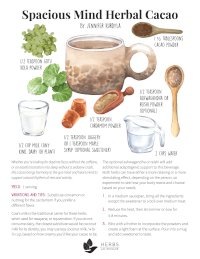
Jennifer shares the many ways she likes to work with gotu kola, including her recipe for Spacious Mind Herbal Cacao—perfect as a coffee alternative or as an evening ritual! You can download a beautifully illustrated recipe card for this delicious herbal beverage from the section below.
Gotu kola isn’t just an herb for the brain! Here are just a few other ways that gotu kola can benefit your health:
► Encourages strong, well-knit tissue repair during wound healing
► Soothes inflamed or ulcerated tissues in the digestive tract
► May slow stress-related hair loss and premature graying
To learn even more gotu kola benefits, be sure to check out the entire episode!
By the end of this episode, you’ll know:
► How gotu kola can help cultivate calm, spacious focus without overstimulation
► The role of gotu kola in calming inflammation—and why that makes it so beneficial for both the body and the mind
► Why gotu kola is so often paired with ghee in Ayurvedic medicine
► A surprising way to work with gotu kola to encourage healthy hair growth
► How nasya (Ayurvedic herbal nose oiling) with gotu kola supports the brian and nervous system
► and so much more…
For those of you who don’t know her, Jennifer Kurdyla is an Ayurvedic practitioner, herbalist, yoga teacher, and writer based in Brooklyn, New York. Committed to sharing the ancient tools of Ayurveda and yoga with modern communities, she helps her clients and students discover personalized rituals that support their well-being in body, mind, and spirit.
Jennifer thrives in the creative space of her kitchen, where she crafts seasonal plant-forward recipes with a focus on supporting digestion and reviving our sensory experience with food prepared fresh and with love. She has studied Ayurveda at the Kripalu School of Ayurveda and clinical herbalism with David Winston.
A former book editor and graduate of Harvard University, Jennifer is also the co-author of Root & Nourish: An Herbal Cookbook for Women's Wellness (Tiller Press), and the author of Sense-Care is Self-Care: Ayurveda and Yoga for Mental Resilience.
I’m thrilled to share our conversation with you today!
Click here to access the audio-only page.
-- TIMESTAMPS -- Gotu Kola Benefits
- 00:32 - Intro to Jennifer Kurdyla + her plant path
- 13:11 - The importance of digestion to overall health
- 17:13 - Gotu kola for the brain and nervous system
- 24:29 - Gotu kola for wounds and skin inflammation
- 25:19 - Nasya oil
- 28:37 - Spacious Mind Herbal Cacao recipe
- 34:23 - Gotu kola for the hair
- 37:00 - Jennifer’s current herbal projects
- 48:15 - Using your senses to learn herbalism
- 50:16 - What Jennifer wishes she’d known when she first started out with herbs
- 54:40 - Student spotlight
- 55:42 - Herbal tidbit
Get Your Free Recipe!
Whether you're looking for daytime focus without the caffeine, or an easeful transition into sleep without a sedative crash, this cacao brings harmony to the gut-mind and heart-mind to support natural rhythms of rest and activity.
Ingredients:
- 2 cups water
- 1/2 cup milk (any kind, dairy or plant)
- 1 ½ tablespoons cacao powder
- 1/2 teaspoon cardamom powder
- 1/2 teaspoon gotu kola powder
- 1/2 teaspoon ashwagandha or reishi powder (optional)
- 1/2 teaspoon jaggery or 1 teaspoon maple syrup (optional sweetener)
Directions:
- In a medium saucepan, bring all the ingredients except the sweetener to a boil over medium heat.
- Reduce the heat, then let simmer on low for 5-8 minutes.
- Blitz with a frother to incorporate the powders and create a light foam at the surface. Pour into a mug and add sweetener to taste.
i
Connect with Jennifer
- Website | JenniferKurdyla.com
Transcript of the 'Gotu Kola Benefits' Video
Welcome to the Herbs with Rosalee Podcast, a show exploring how herbs heal as medicine, as food, and through our relationship with the living world around us.
Today, we’re asking the question, “Can herbs heal the brain?” It’s a question many people are wondering, especially in this world where stress, trauma and cognitive overload kind of feel like the norm. In this episode, I’m joined by herbalist Jennifer Kurdyla to explore the many layers of gotu kola, an herb that’s long been revered for its relationship with the brain, the nervous system, and even connective tissue. She shares about clarity without overstimulation and what it means to support the nervous system over time, rather than chasing quick fixes. This is a conversation about slow medicine, steady repair, and deep resilience that can grow when we work with herbs in relationship, listening closely to both the plants and our own bodies.
If you enjoy this episode, please consider giving it a thumbs up so more plant lovers can find us, and be sure to stay with us until the very end for your herbal tidbit.
Tired of herbal overwhelm?
I got you!
I’ll send you clear, trusted tips and recipes—right to your inbox each week.
I look forward to welcoming you to our herbal community! Know that your information is safely hidden behind a patch of stinging nettle. I never sell your information and you can easily unsubscribe at any time.
Rosalee de la Forêt:
Jennifer, I’m so thrilled to have you here. Thanks for joining us.
Jennifer Kurdyla:
Thank you so much, Rosalee. It’s a pleasure to be here. I’m happy to be sharing some herbal goodness with all of you today.
Rosalee de la Forêt:
I am so looking forward to this and I’m really excited to hear about your story. I have to say, when people are from New York City, Brooklyn, all of that—I’ve never been and I find it so fascinating to talk to urban—urban herbalists. Even just now, we were talking before we got started about how it just snowed. I was like, “What do you do with all the snow in the city? I don’t even know,” so I’m excited to hear how the plants have found you, what it’s been like to be on this plant path and just hear how your story has evolved and brought you here to us today.
Jennifer Kurdyla:
Yeah, absolutely. I will say that my plant journey has been a little bit unconventional, and maybe unexpected even just from my perspective. I didn’t grow up in the city, but I grew up in the suburbs. I was not really that much into nature growing up as a kid, or even really into science. I had a lot of access to nature. We had a beautiful backyard. We had parks and things, but my relationship with nature was not very reciprocal. I didn’t even think of it as something to have a relationship with. It was just in the background. I was much more of a bookworm. I love to read and I spent a lot of time indoors studying, and so nature didn’t really affect my life in a big way until later on.
It was actually when I was studying biology, I—I really hated plants. I hated studying about plants. I remember talking to my mom and saying, “Why do I have to learn about plant cells? They have nothing to do with me. I’m not a plant. This is a crazy thing for me to be spending my time on,” and then years later, I was actually working in book publishing. I was an English major in college and then was working in a book publisher in the editing department. We were working on a book that I highly recommend called, Lab Girl, by Hope Jahren. It’s a book about a scientist. It’s sort of a memoir as well. She wrote these incredible vignettes about nature that were full of awe and wonder, and talking about nature in a way that I had never really heard a scientist talk about anything. She was such a beautiful writer, and of course, telling these wacky anecdotes of experiments and field trips that she would do with her lab partner. That really opened my eyes to a different way of understanding nature and plants. And then a little bit later on, I was working on another book, compiling the writings of John Muir, who, of course, is one of the most revered naturalists in the last couple of centuries. And so, between those two, I sort of started getting a little bit more curious about plants.
Where I lived at the time, I was living in Manhattan and I had a lot of access to Central Park and Riverside Park. Those parks, even though I wasn’t quite aware of it, were such a—a—an antidote to the busyness of my life and I—I really relished them as a refuge from all the work that I did in my head and on the computer. I—when I moved to Brooklyn, actually, in 2018, I knew that I needed to be near another park, and so now, I live near Prospect Park which is an amazing park. I’ve actually done some herb walks with my teachers and led herb walks in Prospect Park. It’s amazing that we have these beautiful, little hubs of nature that feel so rich. You go into the park and you don’t really realize that you are in the middle of the city. Yet for someone like me, I really—I enjoy living in the city. You still are close enough to civilization and the busyness that helps you ground and center me in a certain way. It’s a beautiful mix of those two things.
The way that I found herbalism was sort of on a parallel track. In conjunction with while I was working in publishing, I was also studying yoga and practicing yoga and making some changes in my personal life. I was adopting more of a plant-based diet. I was getting into plants more from a food perspective, and that was one of the first steps towards the cookbook that I published a couple of years ago called Root & Nourish. I was learning how to cook through plants, learning how to experiment with plant foods, with spices and herbs, especially to make things tasty, really more than anything else. Through my yoga studies I had discovered Ayurveda. Ayurveda was a game changer in my life because I had had chronic digestive problems for quite a while that no one could really figure out. No one could give me really effective remedies or remedies at all. They will just look at me. Doctors would look at me with a raised eyebrow and tell me that they didn’t know what to do to help me. And then I went to see an Ayurvedic practitioner, and she not only understood what I was describing. She understood my symptoms and gave them a name, and she acknowledged it. She also really took in my whole life in a way that no one had ever asked me. I had had digestive problems and no one ever asked me about my diet, ironically. This was a brand new experience to make these connections, and actually get help.
One of the first herbal formulas I used was this Ayurvedic formula—very common, many people have probably heard of it—called triphala, which has a lot of uses besides for digestion, but it’s most commonly used for that, especially nowadays. It was amazing. I just didn’t expect to really have any benefits. I went to this practitioner as a final act of desperation, thinking, “What could I lose if I go to this session?” and to have such a complete turnaround of my symptoms in a relatively short amount of time was nothing short of miraculous. I was hooked on Ayurveda and I continued to follow that lifestyle and those dietary principles for a while. And then as I was looking to make my way out of book publishing, I wanted to study Ayurveda more intensively, so I went to school for Ayurveda at a beautiful center called “Kripalu” in the Berkshires in Western Massachusetts, and learned all about Ayurvedic herbs there, which was wonderful. Again, making these connections between plants and their many powers and their beautiful personalities that I hadn’t really thought of before.
The way that I work with plants now in my own practice and for myself and with clients as well, is really in this service of storytelling. I like to think of that as an integration of these different parts of my life where when I’m working with someone, it’s really about helping them unfold and peel back the layers of their own story, not only as it relates to their condition or their disease that they’ve come for support with, but also their life overall, and how does this incident, how did these set of symptoms fit into that; but also empowering people to rewrite their story, to continue to write something about something else and to re-imagine how the rest of their story is going to go.
Plants can be just like a character in a book. They can come in and really change everything. They can upend everything that they thought was going to happen and letting plants reveal themselves in the way that characters can do in a book. I have never really written fiction much. I write much more in the nonfiction space, but I used to edit fiction. I would edit novels. That was my main area of expertise. When I would talk to writers all the time, that’s—that’s what they would all say, that characters, plots, storylines – they just came to them and unfolded. They didn’t have to fashion something out of nothing. I really believe that plants have that same power. There are so many different facets to how they can work on the body. That’s why they’re such beautiful healing partners, and that they might even be working on something that you didn’t even know was a problem. Then this thing that you—you thought was normal—this—this happens so often where the way that you feel or the way that your body is functioning for, maybe your whole life or maybe an extended period of time suddenly changes and you think, “Wow! I thought this was this stable reality or this—I thought this was the same for everybody, and now it’s different.” The relationship that you’ve built with a plant or a formula has helped to shift that dynamic and really helped you to see yourself in a different way.
Rosalee de la Forêt:
Thank you for sharing so much of that. I have to go back. You edited Lab Girl? Part of the editing team?
Jennifer Kurdyla:
I—I was part of the editing team, yes. I wasn’t the acquiring editor. Yeah. Are you a fan of the book?
Rosalee de la Forêt:
Yes. I read it when it first came out and I remember loving it. It’s kind of funny. Now, I’m like I don’t even remember what was in there. I just remember really loving that book. I remember telling everybody about it and loving it, so that’s really cool you were part of the editing team on it.
Jennifer Kurdyla:
Yes, yes. It was an incredible process, very special book.
Rosalee de la Forêt:
What a cool story too that that was part of—helped shift your reality and helped shift your—your life, really, as you started turning towards biology and plants and nature and everything, that’s so lovely.
Jennifer Kurdyla:
Yeah, exactly. Yes. Now, I really see—you know I mentioned having this aversion to science. Still, I definitely lean more towards the—the artistic and the spiritual side of herbalism as well. I can really—I respect and revere the rigor of science and the ways that—it’s amazing our capacity to study things. I have some qualms with how we understand herbal—herbal products, herbal formulas; just single herbs even in the context of the scientific method. I don’t know if those two are exactly working on the same plane, but the fact that we can get so much information from what we understand as scientific experiments these days, I think is amazing.
Even going back to more traditional systems like Ayurveda or Chinese medicine, they may not be using the same tools or metrics as we use today for science, but certainly, a scientific approach, very, very detailed. I think if more people understood the rigor in a different way—the rigor with which things were made and tested and observed, there may be some more overlap and more mutual respect between herbal communities or I guess holistic medicine and allopathic medicine.
Rosalee de la Forêt:
Yeah, that’s so true. You know, Jennifer, you said that your plant path has been somewhat unconventional, but I feel like it just really mirrored my own, actually. I was—I have been a hardcore reader my whole life, and as a kid, especially. I just spent a lot of time with my nose in books. I remember my dad in high school looking at the classes I had chosen to take. He was like, “You have to take anatomy and physiology. Why wouldn’t you do that?” I was like, “No. That has to be so boring. No way.” He was just like, “This is your body! You get to learn how it works.” I was like, “Absolutely not.” I remember being so opposed to it. I was opposed to it before he recommended it, and then even more opposed since he recommended it. Because you know how it is-
Jennifer Kurdyla:
Of course, yes.
Rosalee de la Forêt:
Now, I spend so much of my life being in awe of anatomy and physiology, teaching anatomy and physiology. It’s one of those similar things of like, “Oh, that shifted.”
Jennifer Kurdyla:
Absolutely.
Rosalee de la Forêt:
And then likewise, had an illness that people couldn’t figure out until herbs did and practitioners, so I love that. I feel like hats off to Ayurveda. There is something I love—every system of medicine, every system of herbalism has these wonderful things to offer. There’s something about Ayurveda and digestion though. I feel like I could name five herbalists who were struggling with digestion, specifically. I mean, this is before they were herbalists, and Ayurveda came in and really helped their digestion; totally changed their perspective on life and they became herbalists because of it. There’s just something special about Ayurveda and digestion, I think.
Jennifer Kurdyla:
Yes, I mean digestion is everything. That’s the basic tenet of Ayurveda, basically. Agni, our digestive fire, is the key to all of our—all of our life. The way we process food, if we’re not absorbing and digesting food, then we can’t build healthy tissues. We can’t have energy to—to think and to understand, to use our minds. Agni is really the core of everything. It’s the core of our immune system. We really talk about agni and depletion of agni or imbalances with agni as the cause of all disease. That’s what they say in the—in the classics. First line of all of the books is about how agni is the most important thing.
When we look at a broader perspective even, when we situate Ayurveda in the broader Vedic philosophies, there’s also astrology and all these other things. The sun is at the center of our universe, and so there are so many layers in which that fire component is really central to our existence.
I think for anyone in—in the world who has ever had indigestion, it’s very hard to think about other things when you have any kind of indigestion, whether it’s some symptom after eating or something that’s affecting your appetite or something affecting your elimination; something where you don’t—you’re not getting energy from food, it really affects your life. Even when—I’m sure many herbalists who are listening to this or even people who are dealing with this themselves, when you are in the situation when you have a restricted diet, it really affects your life on so many levels. There’s an element of fear, of pulling back, of social withdrawal because, “I can’t go to this place,” “I can’t go to that party,” “I can’t go to that restaurant. What are they going to have for me to eat?” It affects every aspect of your life, and so having healthy digestion is key to your physical health, your mental health, your emotional health. I think part—part of why Ayurveda is so good at that is because we recognize all of those facets as part of health, and as part of your being, yourself. Managing digestion is at—at the—at the core of everything that we do—all of our practices. It’s always the first step in any herbal protocol. I mean, any healing protocol is making sure digestion is working.
Rosalee de la Forêt:
Absolutely. I just—I just have to chuckle that you went to see all these medical doctors and they didn’t ask what you eat—you’re eating as you had these digestion problems-
Jennifer Kurdyla:
I know.
Rosalee de la Forêt:
Yet we’re the weirdos, you know.
Jennifer Kurdyla:
I know, yes.
Rosalee de la Forêt:
That’s like—that’s kind of a funny thing. Funny sad. You could call it funny sad.
Jennifer Kurdyla:
Yes, yes. It’s funny now. It was not funny then.
Rosalee de la Forêt:
Hey, there. Just a quick note: if you’d like to hear from me in a more personal way, I’d love to have you in my free text community. I send a couple of texts every week, things like behind-the-scenes updates, herbal thoughts that I’m chewing on, and little sparks of joy I don’t always share anywhere else. To join, just text the word ROOT, to 1-509-383-8398, and if you ever want to break up, no hard feelings. Just text STOP to the same number, and you’ll be opted-out immediately. My goal is to make it so juicy and so fun that you look forward to getting my texts each week. Okay, now back to the show.
Well, thank you so much for sharing your story with us, Jennifer, and for this—I think we cannot love on Ayurveda enough. Just the wisdom and the thousands of years, and just how much wisdom there is, how much—I mean, Ayurveda formulas are so brilliant. I love Ayurveda materia medica.
Jennifer Kurdyla:
Yes.
Rosalee de la Forêt:
Where would I be without things like turmeric, just to name the big one. Turmeric, ginger and you’ve chosen today for us, gotu kola, which is something I have an increasing interest in, so I’m really excited to hear what you have to share about gotu kola.
Jennifer Kurdyla:
Gotu kola is an herb that also found me. It was not something that I ever really thought I would use in my life. Gotu kola, Centella asiatica, is a very cool and bitter herb. For my constitution, those are qualities that I don’t really want to increase necessarily. Gotu kola is often used as a—it’s called “medhya rasayana,” a rejuvenator for the mind, something that increases focus and concentration and memory. Knock on wood. Thankfully, I never really had too many struggles in that area. If anything, I have maybe too much focus sometimes, so looking more towards the calming, soothing, softening herbs for my mind. But then a couple of years ago, I got very sick, actually. I was having these fevers that, again, sort of mystery thing that no one could—no one could diagnose. They were getting pretty bad, so I reached out to my teacher, my Ayurvedic teacher and practitioner. She recommended a formula for me that had gotu kola and some other herbs in it as well. Over the course of our talking about what was going on—and I had sort of had this instinct as well—we decided that the fever was psychological. This is something that the doctor I had seen was like totally [unclear] She was like, “There’s no way this is just psychological.” I was like, “Okay, but there’s nothing else going on.” I didn’t even feel sick. I didn’t have any other viral symptoms or anything like that. In any case, I was working with gotu kola and really felt the effects.
Before I go deeper into that particular herb, I just want to clarify that there is actually two herbs that are called “brahmi” in the Ayurvedic materia medica and Ayurvedic formulas, and things like that. One is gotu kola, as we’ve been talking about, and one is bacopa or Bacopa monnieri. They’re often used together and somewhat interchangeable even though they are totally different plants. They’re not related at all. One grows in North India, one grows in South India. They’re both sort of watery, viny, creepy kind of plants, so it’s really important to get them organic. All of our herbs, of course, but especially these because they can grow in marshy areas and get into funky places where it might not be so great to have stuff absorbed into them. These two different plants have very similar uses for the mind and the nervous system, supporting anxiety and helping with focus and intelligence, and this medhya rasayana descriptor. Gotu kola also has this other—I’ll call it a broad, anti-inflammatory quality that works on a lot of the tissues in the body including the brain; thinking about calming inflammation in the actual brain, so anything having to do with cognition like memory loss, dementia, Alzheimer’s, things like that, but as well other tissues in the system. You could think about inflammation in the GI tract or inflammation on the skin. Gotu kola—I believe we’re both studying with David Winston, correct?
Rosalee de la Forêt:
Yes.
Jennifer Kurdyla:
Yeah, yeah. David likes to always say his little mantra for gotu kola is anything that’s red hot and inflamed is where you would apply gotu kola. There’s many different formulas, especially in Ayurveda where we use gotu kola in different forms, especially combined with ghee, which is a beautiful carrier or “anupana,” as we call it in Sanskrit, for bringing gotu kola to the brain, but then also to the gut brain.
So, thinking about the gut microbiome, ghee being this amazing source of butyric acid, which is the same thing that the microbes produce in your gut to help feed your gut health. You’re sort of adding in this actual layer of butyric acid via the ghee, and then that helping to bring the herb to—directly to the brain, so ghee will cross the blood-brain barrier. There’s this huge anti-inflammatory effect on the brain, but then even zooming out further, in Ayurveda we also talk about the “manas” or the mind in a much more general sense. You could sort of think about it as the nervous system overall, like the peripheral nervous system in that, but also the “feeling mind,” the general field of awareness that is governed by the senses and affects the whole body. We talk about the channels of the body in Ayurveda, the “srotamsi.” It’s described that the channel of the mind, the “mano vaha srotas” lives and moves throughout the entire body.
In my specific instance I was having this overall heat situation that wasn’t necessarily caused by a pathogen or something like that. I really was visualizing. I was imagining this herb just traveling throughout my whole body and calming down the inflammation, and it really helped. It took a while. It took a little bit of time to—to do its thing. It’s really been a friend to me for a long, long time after that, and I take it pretty regularly.
Now it’s a really huge ally for me, especially in working with people with any kind of attention problems. We have all of these diagnoses now around ADHD, but I think anyone living in the 21st century has some sort of attention deficit just because we’re so reliant on our phones, on our computers, and our screens. Gotu kola will give a spacious and expansive, and quiet kind of focus that’s almost the antidote to what caffeine does. If you think about caffeine as someone yelling at you, like a coach or someone just screaming in your ear like, “Get it done! Get it done!” and constricting everything, gotu kola has the opposite effect. It’s very expansive and it gives you a space to take a deep breath. It’s much more sophic in that quality.
Traditionally, gotu kola has been used by the yogis for meditation, that’s why it’s called “brahmi” because it’s referring to Brahman, which is the supreme reality, supreme consciousness. This desire to come close to that supreme consciousness to peel back the layers of materiality through the mind and enter that pretty expansive, sophic place for the mind is what gotu kola helps us to do. It’s a wonderful herb for anything having to do with anxiety, overwhelm, when there’s that feeling of compression and tightness in the mind and in the thinking, calming, focusing, but in a spacious way.
On the flipside, when we think about the other tissues that can it be helpful for, on the skin, certainly, it helps to relieve inflammations like psoriasis or eczema or other kinds of rashes, any sort of histamine response. It’s also really great for wound healing. It helps to knit together the tissue in a way that creates a really strong—strong tissue as opposed to just things fitting together side-by-side like making a seam. It’s more like a basket weave that comes together when gotu kola is around. It’s a great way to support any sort of wounds externally or internally. Like I said before, working with gut ulcerations or inflammations in the gut. It can be really helpful to calm things down in that way, especially when taken with ghee.
The other main formula that we use or method of use with gotu kola as it pertains to the mind, especially, is in nasya oil. Nasya is an Ayurvedic practice where you lubricate your sinuses. We love oil in Ayurveda. We put oil pretty much everywhere that we can. In the nose, you can use oil. There’s a lot of different formulas for nasya, but one in particular is made with ghee. Usually, there’s some other oil like sesame, but it’s cooked in with brahmi and maybe some other herbs as well. When you put it in your nose, it goes right to your brain. It helps to carry the herb across that blood-brain barrier. It can be really helpful in supporting the—that focus—that calm focus supporting sleep. If there’s insomnia, especially that restless, worried sleep where you can’t fall asleep. Of course just on a more simple level, any sort of inflammation, redness, dryness in the nose. We’re talking now in the—in the depths of winter and it’s very dry here—between dry outside, dry heat inside, and so using nasya before bed and in the morning can be a great way to support that. If it has some gotu kola in it, it will be even—even more enriching.
Rosalee de la Forêt:
Wow! Amazing plant!
Jennifer Kurdyla:
Yes.
Rosalee de la Forêt:
I’m taking in that there’s definitely a special affinity for mucous membranes, whether that’s the gut or in the nose; also, an affinity for the skin. Do you know if they have an affinity for tendons or ligaments, and that sort of thing as well?
Jennifer Kurdyla:
I wouldn’t use it so much for tendons and ligaments. I’m sure it would have some healing effect. It’s more of that anti-inflammatory. I guess if there is an anti-in—if there is an inflammation there, it would be helpful, but I would actually more turn to amla in that case, if there’s a tendon or a ligament situation. You could certainly use them together that would actually be a nice combination depending on what’s going on, but it’s not my—it wouldn’t be my #1 choice for—for that kind of thing. Maybe if it was more of a—I’m trying to think. If—if it was a rheumatoid arthritis, yes, where there’s like a hot, damp kind of quality going on.
Rosalee de la Forêt:
Yeah, going with that—the cold, bitter, dry gotu kola.
Jennifer Kurdyla:
Yes.
Rosalee de la Forêt:
I’m curious how you most often work with gotu kola in terms of herbal preparation, also dosage.
Jennifer Kurdyla:
Yeah, sure. So, like I said, as a daily practice, I use that brahmi-ghee nasya pretty much everyday. It’s a very—the amount of gotu kola in it, I don’t even know how you would calculate it because you make a water decoction first, and then you add the fat, and you decoct that further. It’s really the sort of essence of the herb that’s in that that you’re getting. It’s not the actual herb even in the final product. What I use more is the powder, and so I’ll take—I usually take half a teaspoon to a teaspoon of powder a day. That’s a pretty mild dose. It’s not going to be excessive.
I use it to—I make a beverage out of it. The recipe that I shared, the Spacious Mind Cacao, is something that I have pretty regularly. I use the gotu kola with cacao powder. I don’t usually add any sweetener or anything like that to cacao drinks that I make, but I do add some digestive herbs. As we were talking before, digestion is always on the mind, so use a little bit of cardamom. I think that’s in the final recipe that I shared—or some cinnamon or nutmeg, something like that to warm things up and keep things moving and harmonize those two herbs because cacao is obviously pretty heating, and the gotu kola is—is much more cooling. Something that brings them a little bit more into harmony with each other, and also just for flavor because I really love cardamom. I usually have that in the evening, actually. Some people are more sensitive to cacao at night. It can keep them awake, and so if that’s you, maybe try it in the morning. It’s also a great alternative to coffee. As I was mentioning, it’s not that sort of coach-yelling-in-your-ear kind of productivity or stimulation in your system, but it provides that same—that nice sense of focus and clarity in your mind without it being super stimulating. A cacao drink like that is also really nice.
Another really traditional preparation using gotu kola is an even simpler one with gotu kola and ashwagandha. I included ashwagandha as an optional addition in the cacao recipe that I shared just because it’s another great herb that you could add in; also, really supportive for the mind. It’s an adaptogen, so helping support stress. It can be really useful for some folks with insomnia as well. Just brahmi and ashwagandha cooked into milk is also a pretty typical thing. We use milk often as an anupana carrier in Ayurveda, just because of its—the fat content, and so it can really help usher those—those herbs into the deeper tissues of the body. If we’re thinking about rejuvenation for the nervous system or for the bones, the fats sort of cut through and go a little bit deeper into the system, and also provide this heavy quality; this density that can help with sleep onto itself. But if you’re working with things that are a little bit more stimulating, the herbs, themselves, both ashwagandha and gotu kola, they’re relaxing but they’re also—they make you feel awake in a certain way—awake relaxed if you have them with milk. Most often, we’re talking about dairy milk, but you could also use coconut milk as the closest alternative as a plant milk, will bring that down a little bit so that you’re not as awake in your mind, but you’re clear and focused so that you can have really restful sleep.
We were talking about digestion before and sleep is really one of the main—main factors of complete digestion. We talk about this whole digestive process that happens while we’re asleep, especially between the hours of 10:00 P.M. and 2:00 A.M. We call that the “pitta time of day,” and there’s another pitta time of day in 10:00 A.M. to 2:00 P.M. Pitta is the dosha of fire, the dosha of transformation when things are being cooked, essentially. At night, your body is doing all of this cooking, all of this housekeeping as it were. If things are clear and spacious while that’s happening while you’re sleeping, then you get an even fuller digestive process. You wake up feeling clear. You wake up ready to digest the food for the next day and all of your experiences for the next day.
Rosalee de la Forêt:
I love all the—the interwoven aspects of how digestion-
Jennifer Kurdyla:
Yes.
Rosalee de la Forêt:
Weaves into everything. This recipe that you’ve shared with us, the “Spacious Mind Herbal Cacao,” really does look incredible. I love how you’re using all these powders, and you mention ashwagandha as an optional or you have reishi down as an optional, which sounds amazing. And then you’re blitzing with a frother to mix all the powders together and giving it that frothy thing that we all know and love. That sounds amazing. Listeners, you can download your copy above this transcript. My favorite thing about sharing recipes is hearing when people make them, so when you make this, let us know in the comments how it was for you. I—this is going to be amazing. I can’t wait to make it myself. I’ve just ordered gotu kola, so that’s on the way. I’m never without cardamom because life’s—that’s a necessary part of life [crosstalk]
Jennifer Kurdyla:
Absolutely.
Rosalee de la Forêt:
This is lovely. Thank you so much for sharing this recipe with us.
Jennifer Kurdyla:
Of course, my pleasure.
Rosalee de la Forêt:
Hey, it’s Rosalee. You know, creating this podcast has been one of the most rewarding parts of my herbal work, and if you found something meaningful here, whether it’s a new perspective, a favorite recipe or just a sense of calm, I want to let you know there’s a good way to go even deeper. It’s called the “Podcast Circle.” Inside you’ll get access to live classes taught by some of my favorite herbal teachers, behind-the-scenes updates, and a beautiful library of herbal resources that we’ve gathered over the years. But more than that, it’s a space to connect with fellow plant lovers who care about the same things you do. And truly, your membership helps make this podcast possible. It’s how we keep the episodes coming and the herbal goodness flowing. So, if you’re ready to be part of something more, something rooted in connection, head over to HerbalPodcastCircle.com. I’d love to see you there.
You’ve covered a lot about gotu kola. Is there anything else that jumps to your mind before we move on?
Jennifer Kurdyla:
The only other thing I would share about gotu kola is that there is some support for the hair. We were talking about the mind and the brain, inside of your actual head, but in Ayurveda, we are talking about the pitta dosha, that fire. There’s a lot of fire in—in our heads just because there’s so much activity going on. If you ever go outside on a cold day, sometimes you can literally see the heat coming off of your head, especially depending on certain personalities.
We talk about—we talk about hair fall, losing your hair or premature graying as an excess of pitta dosha. There’s too much heat in the head and it literally burns the hair off or burn the hair follicle, so brahmi is often used—gotu kola is often used in hair oil formulas, along with some other herbs, especially bhringaraj, that are all really cooling and soothing for the head. A really simple oil that you can use, really easy to make at home is just an infused coconut oil with brahmi. Again, you could do the double decoction method with a water decoction first, and then you add the oil, and apply that to your scalp at night. You can leave it on overnight or just a couple of hours, wash it out in the morning. If you do that pretty regularly, maybe not everyday, depending on—see how your hair reacts and things like that—but at least once a week. It may not—it may not restore hair that has gone gray already, but it might slow down the graying process or slow down the hair fall process. If it’s hair fall that’s occurring not necessarily with aging, and especially more with men where it’s maybe a little bit more typical to lose one’s hair with age; if it’s more happening randomly or from stress—that’s certainly happened to me during stressful times when it’s like you’re brushing your hair, and there’s like, “Where did this come from?”—it will sort of help to reverse that so that you’re not losing as much hair anymore, and more healthy hair starts to grow back. Another great self-care remedy that you could add to your routine using a brahmi oil for your scalp, and then of course, it will help to make your hair nice and shiny and thick too.
Rosalee de la Forêt:
I love that in oils, again, because we love oils, so lovely, lovely. Thank you so much for sharing all of that with us. I’m really excited to get to know gotu kola more, so I feel like it’s the start of something beautiful.
Jennifer Kurdyla:
Yes.
Rosalee de la Forêt:
Well, I’d love to hear what you have going on in your herbal world, what offerings you have. I’ve got one of those here, beside me, which I’m really excited to talk about, and something new that just came out too, so I’ll let you take it away.
Jennifer Kurdyla:
Yeah, absolutely. So, I—like I mentioned, I published a cookbook a couple of years ago called Root & Nourish, and that has been such a wonderful thing. Rosalee is doing a little show-and-tell for us. A wonderful—it was a wonderful project in my life. I’ll give a shout out to my co-author, Abbey Rodriguez, who, at the time, I had been studying Ayurveda and she was the Western herbalist in our partnership. I’m so happy that I was able to follow her lead and do my own studies, but that book is such a beautiful resource to introduce people to how to use herbs and spices in a more health-oriented way. I think a lot of us know herbs and spices for their flavor, which is certainly part of health because part of health is our—our emotions and our enjoyment, and our pleasure, and our desire for food, and our desire for company around food. All of that is very important, but in the book, we wanted to show people how to use herbs in a way that wasn’t just herbal formulas. People think a lot about either a more formal formula, like a tincture or a blend of powders or something like that or even herbal tea which can take a very medicinal format. A lot of folks drink herbal tea just as a beverage, but there’s plenty of herbal teas and increasingly so out there, even herbal coffees and all these herbal things that we can drink all-day long.
Thinking about food and your meals really as the place to receive medicine, which is something that we’re—we’re doing all the time and how to enhance the digestibility of certain foods and just get microdoses of these plants in our bodies all the time, also as a way to support our microbiome. The more diversity we have in our diet of plant foods, the happier our gut microbes are. The book is divided into a couple of sections, working with digestion, mental health and hormonal health. There’s a lot of different ways to work with a particular condition if you have something going on. But even if you don’t, you can just enjoy the recipes as you like and experiment and use the recipes as a guideline, as a—as an inspiration for your own flavor profiles in your own proportions, in your own herbal combinations. You really want folks to use the book as an inspiration for their own experiments in the kitchen and to see what works for them, and even notice changes of how things shift from season to season, or maybe this herb or this spice was something that you love and use everyday for a couple of months or a couple of years, and then all of a sudden, something new came into your life, so having the permission to experiment in the kitchen was a real part of what we wanted to offer in that book.
I have just also published a second book called, Sense-Care is Self-Care. It sort of picks up in a similar vein of using daily routine as part of our ability to support our minds. The subtitle of that book is Āyurveda & Yoga for Mental Resilience, so thinking about the mind as not just a tool for thinking and cognition and productivity, but as an intermediary between our external world and our internal world. That’s how the mind is generally described in both yoga and Ayurveda, and creating a suppleness in our ability to respond to things in our environment.
I think a lot of time, folks imagine their mind being totally calm or turned off, is a very common way people approach meditation or yoga practice of, “I just want to turn off my mind” or “get out of my head.” While I totally understand that ambition, and still sometimes crave that in a certain degree, there is—that’s really not the goal of yoga practice or meditation or of Ayurveda. We’re not trying to escape anything. We want to be more integrated. We want to direct our attention more inward, more towards ourselves. All of the practices that are described in the daily routine—I mentioned earlier about that oiling of the nose, the nasya. That’s just one of the many practices that are recommended to do everyday as part of your daily hygiene for your sense organs. The senses, as this intermediary between our external world and our internal world, are always digesting.
So, back to digestion again where everything you take in through your senses, whether it’s this podcast or something you saw on your social media feed or a conversation that you had with your partner or your boss or your roommate, or the food that you just ate for lunch or dinner – all of those are things that you need to digest in a certain way. We want the sense organs to be clear and robust and able to digest as much as they can, and also able to discern, “What is the thing that I need to really pay attention to? What is something that I don’t need to pay attention to? Is this a real threat? Is this a danger? Is this a stressor that I need to have a full body reaction to and get ready for flight, fight or freeze? Or is this not something that I need to be that stressed out about?
Our—our current state, generally speaking, just given the overwhelm of information that we have coming in through our senses into our minds is depleting that suppleness and that resilience. This is why so many people have this nervous exhaustion, have impaired digestion because their senses are digesting so much, how do you expect your—your belly to digest your food? There’s—there’s only so much fire go around, and so if the fire is going out to deal with the external world, there’s not that much left to deal with your food that you’re putting in your body. You can eat the perfect diet and if you’re not able to digest it, it’s not really going to help you out.
The book is all about tending the senses, really, and using these traditional practices from the daily routine called “dinacharya,” but also, a bunch of other practices that I pulled together from different traditions, yoga practices, things from traditional Chinese medicine, sort of somatics, just daily meditative kinds of practices. Again, you could build your own routine, try things on, see how they work for you, and really go step-by-step.
Something that I explained in the beginning of that book is taking the scientific approach, which now that we’ve talked about it, is an interesting thing that I can reflect on on my own journey, where doing too many things at once even when we’re really excited or maybe sometimes really desperate looking for a resolution, it can seem like a good idea because one of them is going to work, probably. Maybe there’ll be some synergy at one point or another, but it sort of prevents you from understanding what’s doing what, which practice is doing which, which herb is doing that or some other thing. What’s just happening on its own? What’s changing on its own? Taking things really slowly and steadily is the best way to understand how a practice is affecting you over time, but also is a medicine unto itself, slowing things down and monotasking and remembering our innate capacity for monotasking.
We are not made to multitask. Multitasking is a myth. I think most of us are aware of that by now, but when we try to do many things at once, our digestive fire, our attention, is just pinging back and forth all the time. You can think of this as just like wearing out—I don’t like to use machine analogies for the body, but it’s a pretty good one in this case, where if there’s a gear or something that’s churning over and over again with no rust, it’s going to wear out. It’s going to need more grease or something like that, or the part is going to wear out. It’s the same thing with our mind and our attention, and our physical bodies, our tissues. The slower we can be and the more singular we can be with our focus, I think that’s such a huge medicine unto itself. I really like to teach that—both yoga and Ayurveda, our practice is about paying attention. It’s the art and science of paying attention.
Often—even going back to what I was describing earlier about the storytelling component of this work in holistic health—when someone asks you a question or when you take the time to fill out your intake form or just reflect on how you got to where you are, so many times the answer is just revealed in paying attention to what has happened or what is currently happening. We often don’t have the space or we don’t think we have the space to do that, and so, first step is just seeing what’s there in front of you. Not only seeing, but appreciating with all your senses, feeling it with all your senses. How does this fabric feel on my skin? What is the taste on my tongue? When I eat a food, does it actually taste good or is it something that I’m eating because I think it’s—I’m supposed to eat it? Or it’s because it’s whatever’s around. “How am I actually responding to things with my senses?” is a great first step in understanding what is the state of our health, and maybe how we can make improvements without needing a lot of fancy tools, without needing a lot of—even necessarily outside guidance telling us—telling what’s going on.
In Sense-Care is Self-Care, I do include a couple of different herbal teas and simple herbal remedies, especially in the chapter on digestion to help people get in the habit of—I like to call it a “kitchen sadhana,” a kitchen practice where you feel at home in your kitchen. You’re able to make little batches of herbal spice blends and herbal teas and experiment, pick and choose based on how you’re feeling today. It’s not that, “Oh, I have this one herbal tea and I must drink it every day for the next 20 years.” “I feel a little bit like this today” or “I feel a little bit like that today,” or “I have this blend but I want to add a little bit of orange peel.” I just listened to the wonderful episode on orange peel that you had. “I want a little bit of brightness,” and so feeling the permission to respond in the moment rather than being really frigid about a prescription.
Rosalee de la Forêt:
I love the sense-based approach with your new book. There’s another tangent to go on to. It’s been a couple of years now, but they’ve seen a direct correlation to hearing loss and people developing Alzheimer’s, like a loss of sense-
Jennifer Kurdyla:
Yes, absolutely.
Rosalee de la Forêt:
–leading that. So, to be able to joyfully choose to enjoy our senses and engage our senses as a way of improving our cognitive health just makes a lot of sense. It sounds like a very beautiful offering and thank you for sharing so much about that.
Jennifer Kurdyla:
Of course. The senses are—I mean from an herbal perspective, such a wonderful way to get to know plants. Much of how I came into herbalism was through this mind approach of studying, and then experimenting and seeing how things reacted, but being with plants in nature and just having them in your home, whether they are houseplants or herbs in your cabinet or something like that, smelling them, touching them, noticing how they change over time, that’s how you really get to know their personalities. You know how they want to be used and what’s going to be the best way to interact with them at different stages. Our senses are some of our biggest tools as herbalists as well and herb enthusiasts to get to know even the freshness. I got this package of cinnamon and it doesn’t look right. It looks pale or it doesn’t have that right—the right aroma that I’m expecting, and so understanding the potency of what you have. When has it gone bad? When is it fresh and happy to be used?
Rosalee de la Forêt:
Yeah, that’s so true. That is kind of—that’s one of the joys of herbalism, but the senses, getting to know plants. You’re describing as well some of the practical ways that we can get to know plants as well. I always tell that to people when they say, “Is this herb—I found this herb in the back of my cabinet. Is it still good?” “You tell me.”
Jennifer Kurdyla:
Yes. Smell it.
Rosalee de la Forêt:
Thank you so much for sharing about your books. I know there’s going to be folks out there who want to get their hands on them. What’s the best way they can find your books and to stay in touch with you as well?
Jennifer Kurdyla:
The best way to keep in touch with me is through my website. It’s just my name, JenniferKurdyla.com. I am not on social media too much these days, but if you get on my email newsletter list, which you can sign up for easily on my website, you’ll be able to get all the updates for that and links for the books and a lot of recipes, and other writing about Ayurveda are also on the website. It’s a really robust resource there.
Rosalee de la Forêt:
Wonderful! And as far as your books go, I’m assuming wherever books are sold?
Jennifer Kurdyla:
Yes, absolutely.
Rosalee de la Forêt:
Thank you so much for sharing all of that, and before you go, Jennifer, I have one last question for you, and that question is, what do you wish you had known when you were first starting out with herbs?
Jennifer Kurdyla:
So many things, but it would have been less fun if I had known them ahead of time. I would say a less-is-more approach, for sure, especially when I was first making herbal teas. I was so excited about all the different properties of herbs, and even the tastes of them. I just thought that they would be all good together. I made these tea blends that had ten different herbs in them. Now, I really try to keep things to two or three, and noticing how the flavors compliment each other, and what are the effects. It allows me to be much more precise in what I’m trying to achieve for myself or whether I’m working with a client or even making a recipe. What is—what happens when I change one thing as opposed to trying to figure out what the problem is in a huge mess of a lot of different things together. And so, less is more, I think is a really slow and steady way of getting to know herbs and understanding what their effects are and how they work together, rather than trying to un—untangle a big knot. Even going back to what I was saying about the mind and intention, having a longer term relationship with one herb rather than these “loose acquaintances” as I sometimes think of it. It’s like, “I tried that a little bit, I didn’t like it.” It’s a much more, I think, respectful way of working with herbs.
One of the things that I remember being upset about when I was just starting out was ordering one pound bags of herbs—of loose herbs and expecting to be able to use them all and then realizing, “Umm, I don’t really like that one so much,” or “I don’t really need that one so much.” It was a short-term use or something like that, and so respecting the—respecting the life of the plants and not taking more than we need I think is an important thing for us to remember even as herbs are much more accessible to us, which is a wonderful gift about our—our current state and our ability to access so many things. It doesn’t mean we have to have them all and it’s okay if we don’t have them all, and having a really refined, sort of home pharmacy of maybe five or ten herbs that you can have on hand that are easy to get for you is a great thing to do. You could do so many things with just a handful of herbs. We were talking before about turmeric and ginger, and all of our main Ayurvedic staples that are staples in many different traditions, but just those two herbs alone have so many different purposes. So, less is more, I think is much more the way that I’m leaning. I did my experimenting in the early days and now I’m more choosy about the herbs that I bring into my home, certainly, and my body. When sharing herbs with clients, it can be a safer way of getting to know herbs where I’m not giving you this really intense formula that you don’t know what’s in it or what it’s going to taste like or how it’s going to affect you. Just one at a time, and then you slowly start to build trust over time. Building a relationship I think is much more effective in that less-is-more perspective.
Rosalee de la Forêt:
Well said. That’s definitely one of my main things I wish I had known earlier, although I do also say I’m so happy for the experimenting I did, but there was definitely some herbal waste—wasting going on. I agree with you that the more focused feels so much better on numerous levels like you so beautifully explained. Thank you so much, Jennifer, for being here. Thanks for sharing so much about gotu kola, your lovely recipe, as well as Ayurveda, and—and your books as well. It’s just been a pleasure, so thank you so much.
Jennifer Kurdyla:
Thank you, Rosalee.
Rosalee de la Forêt:
Thanks so much for listening. You can download your illustrated recipe card from today’s episode above this transcript. And if you’re not already subscribed, I’d love to have you as part of this herbal community, so I can deliver even more herbal goodies your way.
Tired of herbal overwhelm?
I got you!
I’ll send you clear, trusted tips and recipes—right to your inbox each week.
I look forward to welcoming you to our herbal community! Know that your information is safely hidden behind a patch of stinging nettle. I never sell your information and you can easily unsubscribe at any time.
This podcast is made possible in part by our awesome students. This week’s Student Spotlight is on Crystal Cash in Georgia. Crystal is a Rooted Medicine Circle student whose capstone project, Rooted in Place: A Journey Through Ancestral Plants and Healing Lands, explored the deep connections between plants, people, and place. Through research, medicine making, and creative storytelling, she highlighted medicinal plants native to the regions where she has lived, while honoring her ancestors and the lands that shaped her lineage. Her work is a powerful reminder that plant medicine is not only about healing the body, but also about restoring relationships—with the land, our ancestors, and ourselves.
To honor her contributions, Mountain Rose Herbs is
sending Crystal a $50 gift certificate to stock up on their incredible
selection of organically and sustainably sourced herbal supplies. Thank
you, Mountain Rose Herbs, for supporting our amazing students!
And
if you’d like grow as an herbalist, we’d love to have you. You can
check out my foundational herbal courses at HerbsWithRosalee.com.
Okay, you have made it to the very end of the show, which means you get a gold star and this herbal tidbit: Gotu kola isn’t just something you take as a tincture or a tea. It’s actually easy to grow and it can be worked with as a fresh food. When you have access to the fresh leaves, you can eat them much like a vegetable. One of my mentors, Karta Purkh Singh Khalsa, often suggests using fresh gotu kola as a part of saag. If you’re not familiar with saag, it’s a South Asian dish made from cooked leafy greens, usually cooked down really well. Herbs can be added, spices, etc. It can be quite yummy. Think of it as this kind of flexible greens dish where all these different plants can be added in. I really love this as a reminder that some of our most well-known brain and nervous system herbs like gotu kola, don’t have to only live in supplement form. They can also be a part of everyday meals.
As always, thank you for joining me. I’ll see you in the next episode.
Rosalee is an herbalist and author of the bestselling book Alchemy of Herbs: Transform Everyday Ingredients Into Foods & Remedies That Healand co-author of the bestselling book Wild Remedies: How to Forage Healing Foods and Craft Your Own Herbal Medicine. She's a registered herbalist with the American Herbalist Guild and has taught thousands of students through her online courses. Read about how Rosalee went from having a terminal illness to being a bestselling author in her full story here.